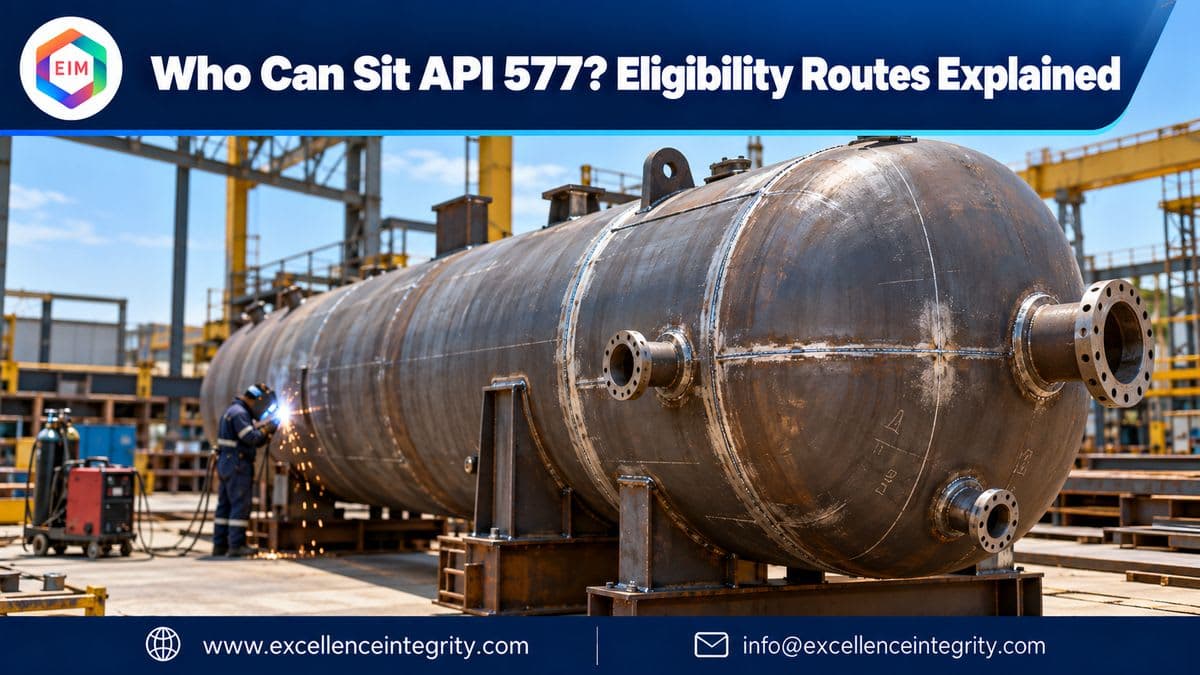
Who Can Sit API 577? Eligibility Routes Explained
Who is eligible for the API 577 exam: the automatic route for API 510, 570 and 653 holders, the education and experience routes, and what to prepare.
Written by Deepak RawtalReviewed by Nilanjan Sen
Published 21 Oct 2026Reviewed 21 Oct 20263 min read
Before you study a single page of API RP 577, check that API will accept your application. There are two ways in: an automatic route if you already hold one of API's inspector certifications, and an education and experience route if you do not. This post explains both, and what to have ready before you apply.
Short answer: If you hold a current API 510, 570 or 653 certification, you qualify for API 577 automatically. If you do not, you need a combination of education and industry experience gained within the last 10 years, typically a relevant bachelor's degree plus 1 year of experience, a 2-year technical degree plus 2 years, or a high school diploma plus 3 years. Check the exact thresholds in API's current eligibility table before applying.
Route 1: you already hold API 510, 570 or 653
Holding a current API 510, 570 or 653 certification automatically qualifies you to sit API 577. You do not need to document anything beyond your active certification status.
The reason is how the certifications fit together. API 510, 570 and 653 each certify inspection authority over one kind of equipment: pressure vessels, piping and storage tanks. API 577 certifies the welding and metallurgy knowledge that sits underneath all three, so API treats an inspector who already holds one of them as qualified to take it. API uses the same pattern for API 571.
Many inspectors take API 577 alongside, or soon after, their first equipment certification, because weld integrity comes up in pressure vessel, piping and tank work alike.
Route 2: education plus experience
Without one of those certifications, eligibility depends on your education and how much relevant industry experience you have gained in the last 10 years. The typical combinations are:
- A relevant bachelor's degree and 1 year of experience
- A 2-year technical degree and 2 years of experience
- A high school diploma and 3 years of experience
Experience older than 10 years does not count towards these totals. API publishes the exact thresholds in its eligibility table for API 577, and they can change between editions, so read the current table before you apply rather than relying on any summary, including this one.
What to have ready
The first application must document your eligibility; recertification later does not ask for employment verification. If you are applying through the experience route, it saves time to gather before you start:
- Copies of your degree or diploma
- Dates of each relevant role in the last 10 years
- A short description of the welding, inspection or fabrication work you did in each
- Contact details for someone at each employer who can confirm it
If you are applying through Route 1, have your current API certificate number to hand.
Where and how you apply
You apply directly to API through its Individual Certification Programs (ICP) portal, not through a training provider. Exams are held at Prometric testing centres worldwide during set testing windows through the year, so check the next window's application deadline early.
Once you are certified
API 577 is valid for 3 years. You can apply to recertify up to 90 days before it expires, and there is a further 90-day grace period after expiry before it lapses and a full re-examination is needed.
Next step
Once you know you are eligible, the exam itself is a closed-book paper with no reference material allowed. The format, the body of knowledge and how it is weighted are covered in our API 577 certification and exam guide, with sample questions from each area.