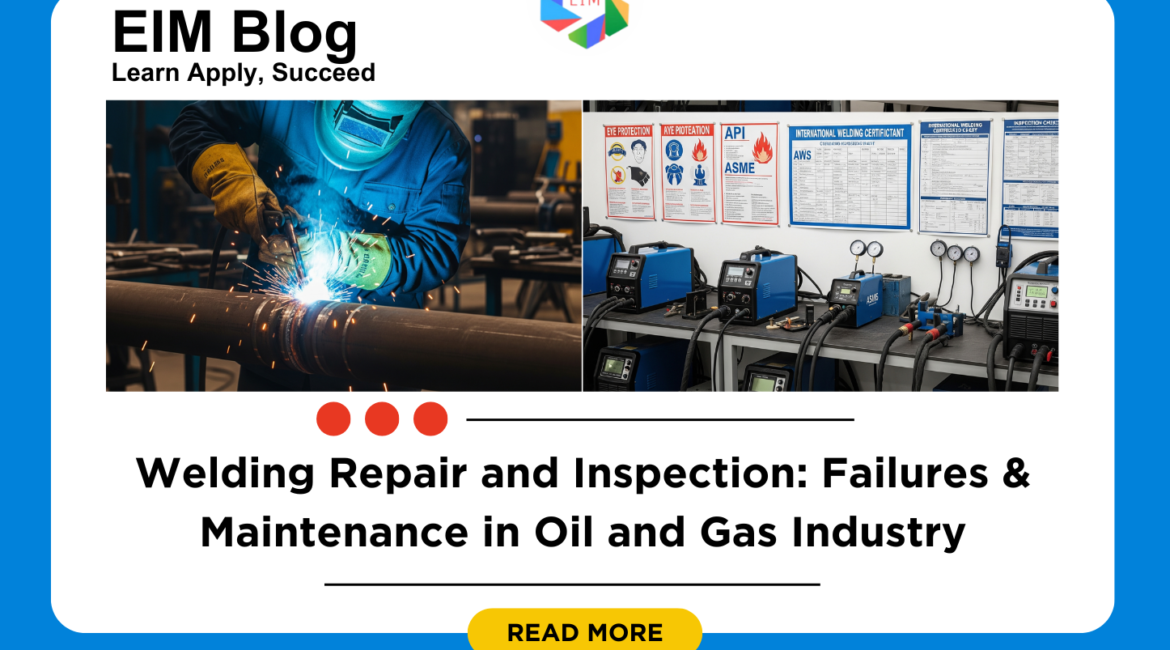
Welding Repair and Inspection: Failures & Maintenance in Oil and Gas Industry
Welding repair and inspection are foundational to maintaining the safety, integrity, and performance of industrial equipment across sectors such as oil and gas, power generation, petrochemical plants, mining, and manufacturing. Proper welding repairs restore the structural strength of critical components like shell-and-tube heat exchangers, pressure vessels, pipelines, boilers, and storage tanks, while thorough inspections help identify early-stage defects that could otherwise lead to catastrophic failures, costly downtime, reputational damage, or environmental hazards.
With industries under increasing pressure to achieve higher efficiency, lower carbon emissions, and zero unplanned shutdowns, welding repair and inspection have never been more important.
Fundamentals And Design Principles
Core Principles of Welding Repair in Industrial Components
Welding repair typically involves restoring damaged metal parts by fusing materials together through localized heating. In industrial settings, shell-and-tube heat exchangers and pipelines are frequent candidates for welding repairs due to their continuous exposure to harsh thermal cycles, vibrations, and corrosive media.
Effective repair depends on:
- Metallurgy Knowledge: matching filler materials with base metals.
- Heat Input Control: preventing distortion or unwanted microstructural changes.
- Process Selection: choosing the right welding method for the component.
Common Welding Processes Used in Repairs
- SMAW (Stick Welding): Versatile, cost-effective, suitable for on-site repairs.
- GTAW (TIG Welding): High precision, clean welds, preferred for critical joints.
- FCAW (Flux-Cored): High deposition rates, good for thicker materials.
- GMAW (MIG Welding): Fast, semi-automated, widely used for pipelines and structures.
Manual Vs. Automated Welding Processes
| Aspect | Manual Welding | Automated Welding |
|---|---|---|
| Advantages | Flexible, low cost, good for complex joints | Consistent quality, higher speed, reduced errors |
| Drawbacks | Skill-dependent, slower, variable quality | Higher setup cost, less adaptable in irregular repairs |
Common Failures & Maintenance Best Practices
Typical Failure Modes Requiring Welding Repair
- Cracks: Due to thermal cycling, residual stresses, or weld defects.
- Corrosion: Uniform, pitting, or stress corrosion cracking in pipelines and exchangers.
- Leaks: Pinholes or failed joints in pressure vessels and tanks.
- Fatigue Damage: Repeated load cycles causing micro-crack growth.
- Erosion: Wear from high-velocity fluids carrying particulates.
Proactive Inspection Routines
- Visual Testing (VT): First-line defense against surface anomalies.
- NDT (UT, RT, MPI, DPT): Detects subsurface and hidden flaws.
- Pressure Testing & Hydrotesting: Confirms weld strength in pressurized systems.
- Drone-Enabled Visual Inspection: Safe, efficient inspection of confined or elevated structures.
Best Practices for Long-Term Reliability
- Maintain weld repair logs for traceability.
- Apply pre- and post-weld heat treatments (PWHT) to reduce residual stresses.
- Implement risk-based inspection (RBI) strategies for prioritizing critical assets.
💡 Mini Case Study: A refinery saved $120,000 by detecting tubesheet cracks early with ultrasonic testing and performing a localized weld repair instead of full exchanger replacement.
Cutting-Edge Applications & Emerging Technologies
Innovations in Welding Materials & Methods
- Low-Hydrogen Electrodes & Nickel Alloys – improved resistance to hydrogen embrittlement.
- Laser & Friction Stir Welding (FSW): Minimal heat-affected zones, excellent precision.
- Underwater Welding: Enables subsea pipeline and offshore structure repairs.
Advanced Inspection Technologies
- Phased Array Ultrasonic Testing (PAUT): Provides 3D imaging of weld defects.
- Digital Radiography (DR): Faster, high-resolution weld imaging.
- IoT-Enabled Smart Sensors: Real-time weld monitoring for stress and fatigue.
- Predictive Analytics with AI: Forecasts weld failures before they occur.
Standards, Certifications & Compliance
Welding repairs and inspections are governed by international standards to guarantee safety and durability:
- ASME Section IX – Qualification of welders & procedures.
- API 1104 – Pipeline welding.
- AWS D1.1 – Structural steel welding.
- ISO 3834 – Quality requirements for fusion welding.
- NACE MR0175/ISO 15156 – Welding in corrosive environments.
Conclusion
Mastering welding repair and inspection is essential to keep industrial assets safe, reliable, and profitable. From understanding failure mechanisms to adopting AI-driven inspection technologies, the industry is evolving toward predictive, precision-based maintenance strategies.
By applying sound welding fundamentals, leveraging modern repair and inspection technologies, following global standards, and investing in skilled workforce training, industries can minimize downtime, enhance safety, and optimize operational costs.