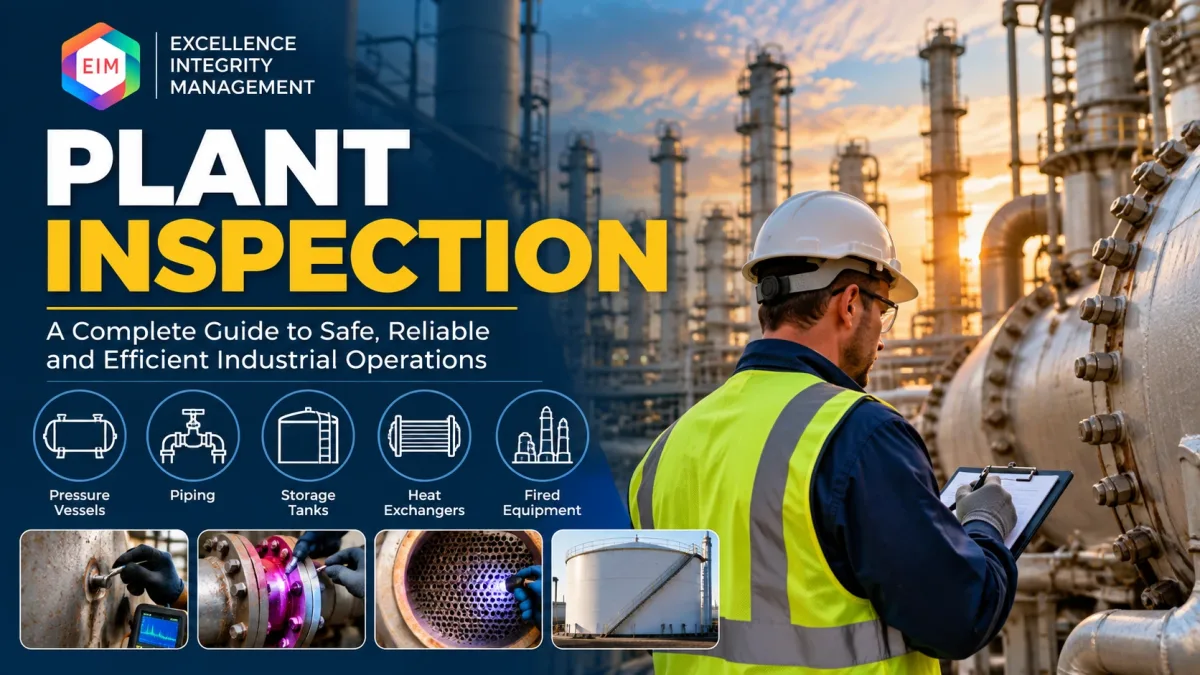
Plant Inspection: A Complete Guide to Safe, Reliable and Efficient Industrial Operations
Industrial plants operate under demanding conditions involving high temperatures, high pressures, corrosive chemicals, mechanical loads, and continuous production cycles. Over time, these conditions can cause equipment deterioration, material degradation, corrosion, cracking, erosion, and other forms of damage.
Plant inspection is a critical process for identifying these conditions before they develop into equipment failures, safety incidents, or costly production interruptions.
In industries such as oil & gas, refining, petrochemicals, power generation, chemicals, and LNG, effective inspection programs help organizations maintain the safety, reliability, availability, and integrity of critical assets.
What Is Plant Inspection?
Plant inspection is the systematic examination and assessment of industrial equipment, piping, structures, and systems to determine their condition and ability to operate safely and reliably.
Inspection can involve a combination of:
- Visual examination
- Thickness measurements
- Non-Destructive Testing (NDT)
- Corrosion monitoring
- Equipment condition assessment
- Inspection data analysis
- Code and standard compliance
- Repair and maintenance verification
The objective is not simply to find defects. A well-designed inspection program aims to understand what is deteriorating, why it is deteriorating, how serious the deterioration is, and whether the equipment can continue operating safely.
Why Is Plant Inspection Important?
Industrial equipment can deteriorate gradually without producing obvious warning signs. For example, process piping may experience internal corrosion for years while appearing normal from the outside. Similarly, pressure equipment may develop localized thinning or cracking that cannot be identified through visual inspection alone.
Without appropriate inspection, deterioration can eventually result in:
- Equipment failure
- Loss of containment
- Hydrocarbon leakage
- Fire and explosion
- Environmental releases
- Unplanned shutdowns
- Production losses
- Expensive repairs
- Personnel safety risks
Plant inspection helps identify potential problems early and provides information needed for maintenance, repair, risk assessment, and continued-operation decisions.
What Equipment Is Inspected in an Industrial Plant?
Pressure Vessels
Pressure vessels are designed to contain fluids under pressure and therefore require careful inspection. Typical inspection activities may include examination of shells, heads, nozzles, welds, internal surfaces, external surfaces, corrosion, pitting, cracking, and wall thickness.
Process Piping
Piping systems transport process fluids throughout an industrial facility. Inspection may focus on pipe wall thickness, welds, flanges, valves, supports, elbows, dead legs, injection points, corrosion locations, and erosion-prone areas.
Storage Tanks
Storage tanks are commonly used for crude oil, petroleum products, chemicals, water, and other materials. Inspection may include the tank shell, roof, bottom plates, annular plates, nozzles, welds, foundation, settlement, and internal and external corrosion.
Heat Exchangers
Heat exchangers operate under thermal, pressure, and chemical stresses. Inspection may include tubes, tube sheets, shells, channels, nozzles, welds, internal corrosion, erosion, and fouling-related damage.
Boilers and Fired Equipment
Boilers, furnaces, and fired heaters operate at elevated temperatures and require specialized inspection. Inspectors may look for thermal damage, tube deterioration, cracking, corrosion, creep-related damage, refractory deterioration, burner problems, and hot spots.
Common Plant Inspection Methods
Visual Inspection
Visual inspection is one of the most basic and widely used inspection methods. Inspectors may look for corrosion, cracks, leaks, deformation, bulging, damaged insulation, coating failure, mechanical damage, and weld abnormalities.
Ultrasonic Testing
Ultrasonic Testing (UT) uses high-frequency sound waves to examine materials. It can be used for thickness measurement, detection of internal discontinuities, weld examination, and corrosion assessment.
Radiographic Testing
Radiographic Testing (RT) uses X-rays or gamma radiation to examine internal features of components. It is commonly used for examining welds and identifying certain internal discontinuities.
Magnetic Particle Testing
Magnetic Particle Testing (MT) is primarily used for detecting surface and near-surface discontinuities in suitable ferromagnetic materials.
Liquid Penetrant Testing
Liquid Penetrant Testing (PT) is used to identify surface-breaking defects. It can be applied to many non-porous materials and is useful for detecting fine surface cracks.
Eddy Current Testing
Eddy Current Testing (ET) uses electromagnetic principles to detect certain defects and material conditions. It is widely associated with applications such as heat exchanger tube inspection.
Understanding Damage Mechanisms
One of the most important aspects of plant inspection is understanding damage mechanisms.
Different operating environments produce different forms of deterioration. Common damage mechanisms include:
- General corrosion
- Pitting corrosion
- Erosion
- Erosion-corrosion
- Stress corrosion cracking
- Hydrogen damage
- Fatigue
- Creep
- Thermal fatigue
- Mechanical damage
Understanding the expected damage mechanism helps inspection teams determine where to inspect, what to inspect, which inspection method to use, and how frequently inspection should be performed.
Risk-Based Inspection and Plant Inspection
Modern facilities increasingly use Risk-Based Inspection (RBI) to prioritize inspection resources according to risk.
Risk can generally be considered through two major factors:
Probability of Failure × Consequence of Failure
RBI can consider equipment condition, process conditions, materials, corrosion mechanisms, failure history, fluid characteristics, operating temperature, operating pressure, and potential consequences of failure.
This approach can help organizations focus inspection resources on equipment where deterioration and consequences may be significant.
Plant Inspection During Turnarounds
A plant turnaround is a major planned shutdown during which equipment can be opened, inspected, maintained, repaired, and returned to service.
Inspection activities during turnarounds may include:
- Reviewing previous inspection data
- Preparing inspection plans
- Equipment isolation and preparation
- Internal inspection
- Thickness measurements
- NDT examinations
- Defect evaluation
- Repair verification
- Final inspection
- Documentation and reporting
Inspection Data and Corrosion Monitoring
Inspection becomes significantly more valuable when data is collected consistently over multiple inspection cycles. Thickness measurements, for example, can be compared over time to identify deterioration trends.
A simplified process can be represented as:
Previous Thickness → Current Thickness → Thickness Loss → Corrosion Rate → Remaining Thickness → Future Inspection Requirement
Historical inspection data can help engineers understand whether deterioration is stable, increasing, localized, widespread, or accelerating.
Inspection Planning
Effective plant inspection begins before the inspector enters the field. A typical inspection plan considers equipment design, materials, service conditions, operating history, previous findings, thickness measurements, NDT results, repairs, and credible damage mechanisms.
The inspection technique should then be selected according to the expected damage mechanism and equipment characteristics.
Plant Inspection Reports
Inspection findings must be properly documented. A typical inspection report may contain:
- Equipment identification
- Inspection date
- Inspection scope
- Inspection method
- Inspection locations
- Measurements
- NDT results
- Observed defects
- Photographs
- Previous inspection comparison
- Recommendations
- Repair requirements
- Inspector information
Accurate documentation creates a traceable history of equipment condition and supports future integrity decisions.
Codes and Standards in Plant Inspection
Plant inspection programs commonly reference industry codes and standards. Depending on the equipment and application, these may include:
- API 510 – Pressure Vessel Inspection Code
- API 570 – Piping Inspection Code
- API 653 – Tank Inspection, Repair, Alteration, and Reconstruction
- API 580 – Risk-Based Inspection
- API 571 – Damage Mechanisms Affecting Fixed Equipment in the Refining Industry
- API 579-1 / ASME FFS-1 – Fitness-for-Service
The appropriate standard depends on the equipment, service, jurisdiction, and inspection scope.
Challenges in Plant Inspection
Plant inspection can be technically and operationally challenging. Common challenges include limited access, harsh operating conditions, hidden damage, aging equipment, large inspection volumes, and time constraints during plant turnarounds.
These challenges make inspection planning, competent personnel, appropriate technology, and accurate documentation essential.
The Role of Technology in Modern Plant Inspection
Technology is transforming inspection practices. Modern facilities may use:
- Drones
- Robotic inspection systems
- Remote visual inspection
- Digital thickness monitoring
- Advanced ultrasonic techniques
- Digital inspection management systems
- 3D scanning
- Data analytics
- Remote inspection technologies
These tools can improve inspection coverage, reduce exposure to hazardous environments, and provide more detailed inspection data. However, technology works best when combined with sound engineering practices and experienced inspection personnel.
Plant Inspection and Asset Integrity Management
Plant inspection is an important part of Asset Integrity Management (AIM).
A simplified integrity-management cycle can be represented as:
Identify Damage → Inspect → Assess Condition → Evaluate Risk → Repair/Maintain → Monitor → Reassess
Inspection provides the physical evidence needed to understand the actual condition of equipment. Without reliable inspection data, it becomes much more difficult to make informed decisions about maintenance, repair, replacement, or continued operation.
Best Practices for Effective Plant Inspection
- Understand the Equipment: Know the equipment design, material, service, and operating conditions.
- Understand Damage Mechanisms: Identify the forms of deterioration that are credible for the equipment.
- Select Appropriate Inspection Techniques: Match the inspection method to the expected damage.
- Maintain Accurate Inspection Records: Historical data is essential for identifying trends.
- Use Risk-Based Prioritization: Focus resources where the potential risk is significant.
- Train Competent Personnel: Inspection quality depends heavily on personnel competence and experience.
- Integrate Inspection With Maintenance: Inspection findings should lead to appropriate engineering and maintenance actions.
- Continuously Improve: Inspection programs should evolve with equipment condition, operating conditions, technology, and industry knowledge.
Conclusion
Plant inspection is a fundamental element of safe and reliable industrial operations.
From pressure vessels and piping systems to storage tanks, heat exchangers, and fired equipment, inspection helps organizations understand the condition of critical assets and identify deterioration before it becomes a major problem.
Effective plant inspection combines:
Engineering Knowledge + Inspection Techniques + Damage Mechanisms + Industry Standards + Risk Assessment + Accurate Data
As industrial facilities become older and operating conditions become increasingly demanding, the importance of structured inspection and asset integrity management continues to grow.
The goal is not simply to inspect equipment. The goal is to understand equipment condition, manage risk, prevent failures, and maintain safe and reliable operations throughout the asset lifecycle.
About Excellence Integrity Management
Excellence Integrity Management (EIM) supports engineers and industry professionals in developing knowledge across asset integrity, inspection, corrosion, materials, reliability, and oil & gas engineering.