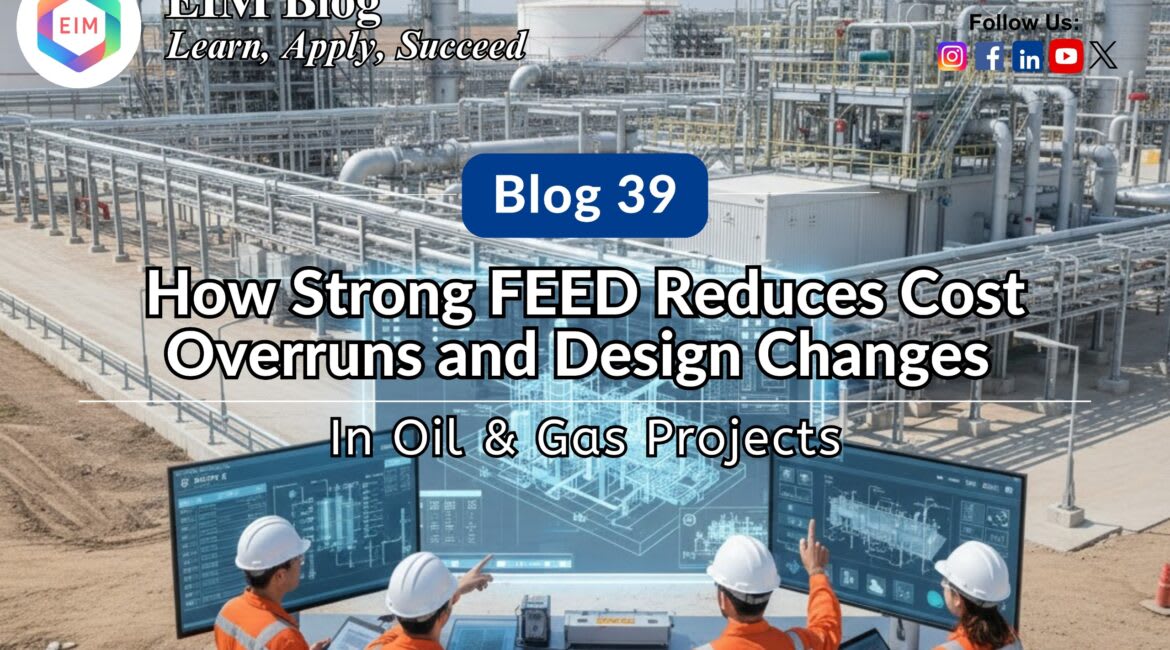
The Importance of FEED (Front-End Engineering Design) in Oil & Gas Projects
Front-End Engineering Design (FEED) is one of the most important phases in the lifecycle of an oil & gas project. It serves as the bridge between conceptual studies and Engineering, Procurement, and Construction (EPC) execution. Decisions made during FEED significantly influence project cost, schedule, safety, operability, and long-term asset performance.
A well-executed FEED phase transforms project uncertainty into a structured execution strategy, helping organizations minimize risk and maximize return on investment throughout the asset lifecycle.
1. What Is FEED — and Why It Matters
FEED bridges conceptual studies and EPC execution. Its purpose is to mature the project definition to roughly 30% design completion and produce Class-3 cost estimates (±15–30%).
Core FEED Deliverables
A complete FEED package typically includes:
- Process Flow Diagrams (PFDs)
- 60–80% developed P&IDs
- Equipment lists and datasheets
- Plot plans and preliminary 3D models
- HAZOP and safety studies
- Risk registers and constructability reviews
- Procurement strategies
- Bid-ready EPC documentation
Unlike early FEL stages, FEED performs quantified trade-offs between:
- CAPEX vs OPEX
- Safety vs operability
- Reliability vs constructability
For asset integrity teams, FEED is also where Risk-Based Inspection (RBI) frameworks are embedded—assigning corrosion mechanisms, H₂S cracking risks, and inspection baselines before steel is even ordered.
2. Why Projects Overrun: The Anatomy of Weak FEED
Poor FEED creates downstream chaos.
Independent audits show that:
- Approximately 80% of cost overruns stem from inadequate early planning.
- Large oil & gas projects average 20–30% budget overruns when FEL and FEED quality is insufficient.
Typical Failure Points
| Gap | Impact |
|---|---|
| Incomplete geotechnical surveys | Foundation redesigns (10–15% cost increase) |
| Limited constructability input | Piping quantities rise 20–25% |
| Over-specification | 10–20% wasted on oversized equipment |
| Late stakeholder alignment | Scope creep adds approximately 15% |
| Deferred safety studies | Expensive redesign during EPC execution |
3. Design Change Dynamics — and How Strong FEED Prevents Them
Projects without rigorous FEED experience 20–50% more design changes, driven by:
- Interface clashes
- Regulatory surprises
- Missing operability requirements
- Late safety discoveries
Offshore projects can experience substantial financial impacts from a single piping clash, while late SIL or HAZOP findings often require valve replacements, control logic modifications, and layout redesigns.
Strong FEED Countermeasures
- Early 3D clash detection (reduces design changes by approximately 40%)
- Iterative HAZOP and Quantitative Risk Assessment (QRA) workshops
- Value engineering sessions
- Specification freeze after gated reviews
- Multidisciplinary constructability modeling
4. Quantified Benefits of a High-Quality FEED
| Benefit | Mechanism | Typical Impact |
|---|---|---|
| Cost Accuracy | Class-3 estimates | 20–30% overrun avoidance |
| Risk Reduction | HAZOP and SIL integration | Up to 80% fewer safety reworks |
| Schedule Gains | Constructability modeling | 3–6 months saved |
| Better EPC Bids | Clear tender packages | 10–15% lower bids |
| Lifecycle Optimization | RBI and maintainability integration | Approximately 15% OPEX reduction |
| Expansion Readiness | Modular layouts | 25% faster brownfield upgrades |
Despite representing only 4–8% of total CAPEX, FEED often delivers a return on investment of five to ten times the original expenditure.
5. Lessons from Major Projects
Chevron Gorgon LNG
Poor FEL quality contributed to significant cost overruns. Post-project analysis demonstrated that stronger FEED practices could have substantially reduced overall capital expenditure.
Shell Prelude FLNG
Rushed early engineering activities and incomplete stakeholder alignment contributed to major cost escalation and schedule challenges.
Oyu Tolgoi (Cross-Industry Parallel)
Insufficient early project definition and geological FEED led to major cost increases, reinforcing the importance of robust front-end planning for megaproject success.
By contrast, several Middle East gas developments using advanced FEED risk modeling achieved:
- Approximately 20% CAPEX savings
- Around six months of schedule acceleration
- Avoidance of substantial rework costs
6. FEED and Asset Integrity: Designing Reliability from Day One
Modern FEED incorporates asset integrity engineering from the earliest stages of design.
Key activities include:
- Early identification of damage mechanisms
- Risk-Based Inspection (RBI) planning aligned with design
- Corrosion-resistant material selection
- Access provisions for inspection and maintenance
Standards such as API 581 enable inspection strategies to be engineered directly into facility layouts, reducing long-term operating costs and minimizing unplanned outages.
7. Digital FEED: AI and Digital Twins Enter the Mainstream
FEED is rapidly becoming a digital-first engineering discipline.
Emerging Capabilities
- Digital twins simulate facilities before construction begins.
- Artificial intelligence optimizes layouts and predicts operability issues.
- Automated RBI tools assign inspection priorities.
- Virtual commissioning reduces startup risks.
Key benefits include:
- 30–50% fewer design iterations
- Earlier detection of constructability issues
- Faster engineering decision cycles
By 2027, AI-assisted FEED workflows are expected to become standard practice across many major energy projects.
8. FEED in the Energy Transition Era
FEED is no longer focused solely on hydrocarbon developments.
Modern projects increasingly require accommodation for:
- Carbon Capture, Utilization, and Storage (CCUS)
- Hydrogen blending infrastructure
- Electrification interfaces
- Waste heat recovery systems
- Modular expansion strategies
Governments and investors increasingly favor technically mature FEED packages when evaluating decarbonization projects and sustainability initiatives.
This shift is driving the emergence of "Green FEED" methodologies that integrate low-carbon pathways into facility designs from the outset.
9. Best Practices for High-Performance FEED
- Multidisciplinary integration from Day 1 (process, piping, civil, and integrity teams)
- Early 3D modeling and clash detection
- Structured value engineering workshops
- Regular gated stakeholder reviews
- RBI integration during layout development
- KPI dashboards for estimate accuracy and risk closure tracking
Common Pitfalls to Avoid
- Rushed project scopes
- Siloed engineering teams
- Deferred safety studies
- Incomplete site investigations
10. Future Outlook: FEED as a Strategic Advantage
By 2030, FEED is expected to evolve into a fully digital and sustainability-driven discipline characterized by:
- AI-optimized facility layouts
- Integrity-led engineering by default
- Hydrogen and CCUS readiness integrated into base designs
- Continuous digital twin utilization from FEED through operations
Organizations that master FEED will consistently achieve:
- Lower CAPEX
- Faster project schedules
- Safer facilities
- Reduced lifecycle costs
- Energy-transition-ready assets
Takeaway
FEED is not a paperwork phase.
It is the financial, technical, and operational foundation of every oil & gas project.
Strong FEED transforms uncertainty into engineered certainty—turning megaproject risk into competitive advantage.
In an era of volatile markets and energy transition pressures, projects do not fail during construction; they fail during FEED.
Invest early. Engineer deeply. Your assets depend on it.