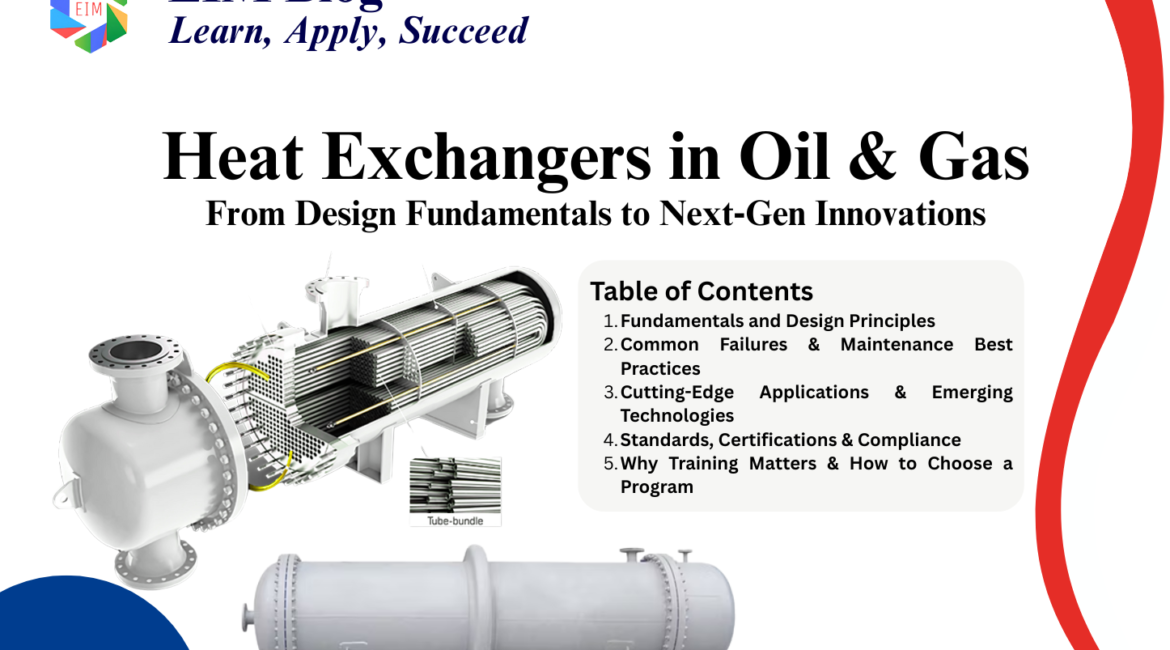
Heat Exchangers in Oil & Gas: From Design Fundamentals to Next-Gen Innovations
Heat exchangers play a pivotal role in the oil and gas industry, serving as the backbone of efficient thermal energy management across upstream, midstream, and downstream operations. From preheating crude oil in refineries to condensing gas in LNG plants, they are indispensable for achieving process efficiency, reducing emissions, and ensuring safe operation.
Given their critical role, understanding how heat exchangers work, how to maintain them, and what new technologies are reshaping their design is essential for engineers and plant managers alike. In this blog, we’ll walk you through the fundamentals of heat exchanger design, explore common failure modes and maintenance practices, delve into cutting-edge technologies, and explain why comprehensive heat exchanger training is crucial for operational excellence.
Table of Contents
- Fundamentals and Design Principles
- Common Failures & Maintenance Best Practices
- Cutting-Edge Applications & Emerging Technologies
- Standards, Certifications & Compliance
- Why Training Matters & How to Choose a Program
1. Fundamentals and Design Principles
Shell-and-Tube Heat Exchangers: Core Design & Operation
The shell-and-tube heat exchanger is the most widely used type in oil & gas operations due to its rugged design and ability to handle high pressures and temperatures.
Core Components
- Shell: A cylindrical vessel containing the tube bundle.
- Tubes: Carry one of the fluids and are arranged in bundles.
- Tube Sheets: Secure the ends of the tubes.
- Baffles: Direct fluid flow to improve heat transfer.
- Nozzles: Allow fluid entry and exit.
Working Principle
One fluid flows through the tubes (tube side), while the other flows around the tubes in the shell (shell side), facilitating efficient heat transfer.
Comparing with Other Types
Plate Heat Exchangers
- High heat transfer efficiency
- Compact size
- Less suited for high-pressure or high-temperature applications
- More prone to gasket leaks
Air-Cooled Heat Exchangers
- No need for cooling water
- Ideal for remote or dry locations
- Larger footprint
- Performance depends on ambient air temperature
Design Standards
- ASME Section VIII: Governs pressure vessel design and safety compliance.
- TEMA (Tubular Exchanger Manufacturers Association): Provides mechanical design guidelines for shell-and-tube exchangers.
Following these standards ensures that the heat exchanger is both efficient and safe under demanding oil & gas conditions.
2. Common Failures & Maintenance Best Practices
Typical Failure Modes
Fouling
- Caused by deposits from process fluids such as scaling, sludge, and hydrocarbons.
- Reduces heat transfer efficiency and increases energy costs.
Corrosion
- Chemical reactions degrade metal surfaces.
- Can lead to tube thinning, cracking, or perforation.
Leaks
- Often result from gasket failure or tube damage.
- May cause product loss, contamination, or safety hazards.
Thermal Stress and Fatigue
- Result from frequent temperature fluctuations.
- Can cause weld cracks or expansion joint failure.
Maintenance & Inspection Best Practices
- Routine mechanical or chemical cleaning of tube bundles.
- Ultrasonic testing to check wall thickness.
- Eddy current testing to detect internal flaws.
- Hydrostatic testing to verify pressure integrity.
- Thermographic imaging to identify flow issues or blockages.
Troubleshooting Tips
- Monitor pressure drops to detect fouling early.
- Watch for unusual temperature readings that may indicate bypass flow or internal leakage.
- Schedule preventive maintenance during shutdowns rather than relying on reactive repairs.
Mini Case Study: Maintenance Savings
At a refinery in the Middle East, regular fouling in a crude preheat exchanger was causing a 10% efficiency loss every three months. After introducing monthly thermal imaging inspections and switching to a high-shear cleaning technique, the unit ran for 12 months without major intervention.
This reduced downtime by 28% and saved more than $150,000 annually in fuel and operational costs.
3. Cutting-Edge Applications & Emerging Technologies
New Materials & Manufacturing
Additive-Manufactured Coils and Parts
- 3D printing enables complex geometries that enhance turbulence and improve heat transfer.
- Reduces material waste and allows faster custom part fabrication.
Advanced Alloys and Coatings
Titanium, Inconel, and specialized coatings are increasingly used to combat corrosion in sour service and offshore applications.
Innovative Applications
Gas Processing Plants
Plate-fin exchangers are now widely used in cryogenic gas separation due to their compact design and high surface area.
Waste Heat Recovery Units (WHRUs)
Reclaiming thermal energy from flue gases or compressors can power turbines or preheat feedstock, significantly improving plant energy efficiency.
Digital Monitoring & Smart Maintenance
IoT Sensors
- Track temperature, flow, and pressure in real time.
- Alert operators to anomalies before they result in failures.
Predictive Analytics
- AI tools analyze historical data to forecast potential breakdowns.
- Enable condition-based rather than schedule-based maintenance.
By integrating smart technologies, companies are extending asset life and minimizing unplanned downtime, creating significant return on investment.
4. Standards, Certifications & Compliance
In the oil & gas sector, compliance with recognized standards is not just best practice—it is a legal and operational necessity.
Key Standards
- ASME Section VIII – Certifies the mechanical integrity of pressure vessels.
- TEMA Standards – Provide guidelines for exchanger construction, tolerances, and materials.
- API Standards (e.g., API 660) – Used for design, fabrication, inspection, and testing in refinery applications.
Why Compliance Matters
- Safety: Prevents catastrophic failures and protects personnel.
- Reliability: Ensures consistent performance under demanding conditions.
- Insurance & Audit Readiness: Certification is often required for regulatory approval and insurance coverage.
For engineers, staying current with these standards ensures both professional competency and project success.
5. Why Training Matters & How to Choose a Program
With evolving technologies and stricter safety regulations, hands-on heat exchanger training is more important than ever.
Why It Matters
- Reduces the risk of failure through better engineering decisions.
- Increases uptime by enabling faster diagnostics and repairs.
- Improves confidence in selecting the right exchanger for each application.
What to Look For in a Training Program
Strong Theoretical Foundation
Covers exchanger types, thermodynamics, heat transfer principles, and material selection.
Design Simulations
Includes practical experience using tools such as HTRI and Aspen Exchanger Design & Rating (EDR).
Field Demonstrations
Provides exposure to real-world scenarios and equipment disassembly/reassembly practices.
Compliance Overview
Covers ASME, TEMA, and relevant industry specifications.
A well-rounded training program equips professionals to confidently handle both design and operational challenges.
Conclusion
Mastering the design, operation, and maintenance of heat exchangers is essential for anyone involved in the oil & gas sector. As systems become more complex and downtime more expensive, combining foundational knowledge with emerging technologies is key to staying competitive.
Whether you are optimizing existing units or exploring innovations in waste heat recovery, investing in robust heat exchanger training can deliver measurable operational and financial benefits.
Join our next Heat Exchanger Training Program and gain practical insights from industry experts. From theory to field application, we’ve got you covered.