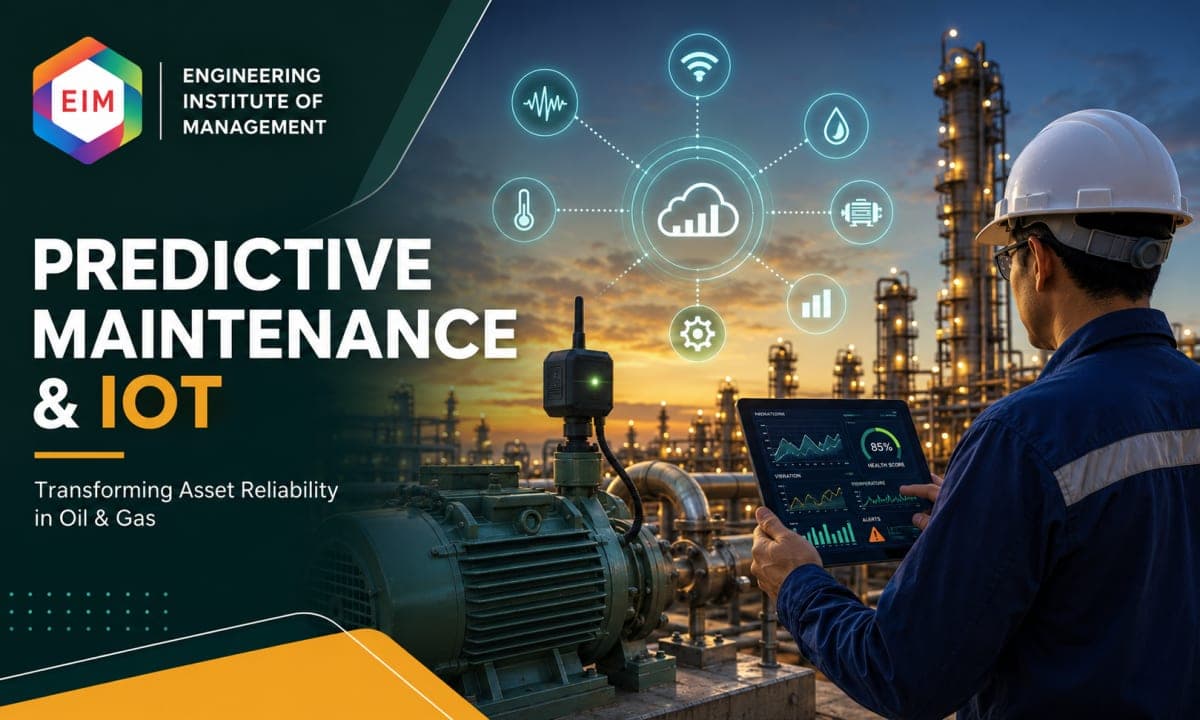
Predictive Maintenance & IoT: Transforming Asset Reliability in the Oil & Gas Industry
Discover how Predictive Maintenance and IoT are transforming oil & gas asset reliability through real-time monitoring, AI, machine learning, digital twins and smarter maintenance decisions.
Written by Harish HaseebReviewed by Kabiruddin Riyazuddin Ahmed
Published 3 Sept 2026Reviewed 3 Sept 20269 min read
The oil and gas industry operates some of the world's most complex and capital-intensive assets. Pumps, compressors, turbines, pipelines, valves and rotating equipment must operate reliably in environments where unexpected failures can result in production losses, safety risks, environmental consequences and significant repair costs.
Traditional maintenance strategies are increasingly being complemented by Predictive Maintenance (PdM) powered by the Internet of Things (IoT), artificial intelligence (AI), machine learning and real-time analytics.
Instead of waiting for equipment to fail—or replacing components according to fixed schedules—predictive maintenance aims to identify early signs of degradation and potential failure so maintenance can be planned at the right time.
What Is Predictive Maintenance?
Predictive maintenance is a maintenance strategy that uses equipment condition data, sensors, analytics and predictive models to estimate when an asset may experience degradation or failure.
The evolution of maintenance can be summarized as:
Reactive Maintenance → Preventive Maintenance → Condition-Based Maintenance → Predictive Maintenance → Prescriptive Maintenance
The objective is not to perform maintenance more frequently. The objective is to perform the right maintenance at the right time.
Why Predictive Maintenance Matters in Oil & Gas
Oil and gas assets often operate under demanding conditions, including high temperatures, high pressures, corrosive environments, vibration, mechanical loads and continuous operation.
A failure in a critical compressor, pump or turbine can affect an entire production system.
IoT sensors and predictive analytics can continuously monitor equipment and identify unusual behavior before it develops into a major failure.
This changes the maintenance question from:
“Why did the equipment fail?”
to:
“What is changing, and when should we intervene?”
1. IoT Sensors Create Continuous Asset Visibility
The Internet of Things connects physical equipment to digital systems through sensors, communication networks and analytics platforms.
Common parameters monitored in industrial equipment include:
- Vibration
- Temperature
- Pressure
- Flow
- Speed
- Torque
- Lubricant condition
- Electrical current
- Acoustic signals
- Valve position
This creates a continuous data flow:
Physical Asset → Sensor → Network → Data Platform → Analytics → Maintenance Decision
2. From Sensor Data to Predictive Intelligence
Collecting data is only the first step. The real value comes from interpreting that data.
For example, if the vibration of a centrifugal pump gradually increases over several weeks, a basic monitoring system may generate an alarm only after a predefined threshold is exceeded.
A predictive system can analyze vibration trends together with temperature, speed, load, pressure and maintenance history to determine whether the pattern resembles previous failure conditions.
This allows maintenance teams to investigate potential problems before equipment reaches a critical failure state.
3. AI and Machine Learning Are Strengthening Predictive Maintenance
AI is becoming an important layer between raw sensor data and maintenance decisions.
Machine-learning algorithms can identify complex relationships between equipment parameters and failure events.
Applications include:
- Failure prediction
- Remaining Useful Life (RUL) estimation
- Anomaly detection
- Equipment health scoring
- Fault classification
- Maintenance prioritization
- Failure pattern recognition
The most effective systems combine AI with engineering knowledge. Algorithms can identify patterns, but engineers must validate whether those patterns make technical and operational sense.
4. Predictive Maintenance for Critical Oil & Gas Equipment
Pumps
Monitoring can help identify developing problems associated with bearing wear, cavitation, misalignment, imbalance, seal problems and abnormal vibration.
Compressors
Important monitoring parameters include vibration, temperature, pressure, lubrication condition and performance degradation.
Gas Turbines
Monitoring can include exhaust temperature, vibration, bearing condition, fuel performance and efficiency indicators.
Electric Motors
IoT systems can monitor current, voltage, temperature, vibration, power consumption and insulation condition.
Valves
Smart monitoring can help identify leakage, positioning problems, actuator degradation and abnormal operating cycles.
Pipelines
Sensors and analytics can support monitoring of pressure, flow, temperature, leakage and other pipeline integrity indicators.
5. Predictive Maintenance and Asset Integrity
Predictive maintenance should not operate separately from an organization's broader Asset Integrity Management (AIM) strategy.
Asset integrity focuses on ensuring that equipment and facilities remain safe, reliable, fit for service and compliant.
Predictive analytics can provide additional condition information that supports integrity decisions.
A typical workflow can be:
Sensor Data → Equipment Condition → Anomaly Detection → Engineering Assessment → Risk Evaluation → Maintenance / Inspection Decision
This creates a stronger connection between real-time operating information and asset integrity activities.
6. Digital Twins Make Predictive Maintenance More Powerful
A digital twin is a digital representation of a physical asset that can be continuously updated using operational data.
A predictive maintenance digital twin can combine:
- Equipment design information
- Sensor data
- Maintenance history
- Operating conditions
- Engineering models
- AI predictions
- Failure information
This allows engineers to compare current equipment behavior with historical and expected performance.
7. Edge Computing Enables Faster Decisions
Not every equipment decision should depend on sending all data to a remote cloud platform.
Edge computing allows data to be processed closer to the equipment.
This can be especially valuable for:
- Offshore platforms
- Remote oil fields
- Pipelines
- Drilling sites
- Gas processing facilities
A simplified architecture is:
Sensor → Edge Device → Local Analytics → Alert / Action
Processing information closer to the equipment can reduce latency and support operations where connectivity is limited.
8. Predictive Maintenance Can Reduce Unplanned Downtime
Unplanned downtime is one of the biggest concerns for asset-intensive industries.
Unexpected equipment failure can result in:
- Lost production
- Emergency repair costs
- Spare-parts shortages
- Additional manpower requirements
- Safety risks
- Environmental risks
- Schedule disruption
Predictive maintenance changes the sequence from:
Failure → Emergency → Repair
to:
Detection → Diagnosis → Planned Intervention → Repair
This gives maintenance teams more time to arrange spare parts, personnel, tools, isolation procedures and work permits.
9. Predictive Maintenance Can Improve Spare Parts and Workforce Planning
Predictive maintenance can provide benefits beyond equipment reliability.
If analytics indicate that a component is likely to require replacement, maintenance planners can prepare resources before an urgent failure occurs.
This can improve:
- Spare parts management
- Workforce planning
- Shutdown planning
- Inventory optimization
- Maintenance scheduling
10. Predictive Maintenance Is Not the Same as Preventive Maintenance
| Maintenance Type | Approach |
|---|---|
| Reactive | Repair after failure |
| Preventive | Maintenance at fixed intervals |
| Condition-Based | Maintenance based on current equipment condition |
| Predictive | Use data and models to anticipate potential failure |
| Prescriptive | Predict the problem and recommend the best action |
11. The Biggest Challenge: Data Quality
Predictive maintenance depends heavily on reliable data.
Common challenges include:
- Missing sensor data
- Incorrect sensor calibration
- Inconsistent timestamps
- Data silos
- Legacy systems
- Limited failure records
- Poor asset identification
- Inconsistent maintenance history
- Different data formats
A simple principle applies:
Good Data → Better Analysis → Better Decisions
Organizations should therefore establish strong data governance before attempting to scale predictive maintenance across large asset portfolios.
12. Cybersecurity Becomes Critical
Connecting industrial equipment to networks creates new cybersecurity considerations.
IoT and Industrial IoT systems increasingly connect:
Physical Equipment ↔ Operational Technology ↔ IT Systems ↔ Cloud Platforms
This makes the following increasingly important:
- Network security
- Access control
- Device authentication
- Data encryption
- Secure software updates
- Industrial control system security
- Incident response
- OT/IT segmentation
13. Human Expertise Still Matters
AI cannot completely replace maintenance engineers.
A predictive model may indicate that the probability of equipment degradation is increasing, but an experienced engineer must determine:
- Whether the signal is genuine
- What the likely failure mechanism is
- Whether operating conditions explain the change
- What inspection is required
- Whether equipment can continue operating safely
- What maintenance action is appropriate
The strongest predictive maintenance systems therefore combine:
AI + IoT + Engineering Knowledge + Maintenance Experience
The Predictive Maintenance Architecture
A modern predictive maintenance ecosystem can be represented as:
Sensors → Connectivity → Edge / Cloud Platform → Analytics → Equipment Health Model → Engineering Decision → Work Management
This creates a connection between the physical asset and the maintenance organization.
Key Benefits of Predictive Maintenance & IoT
- Reduced Unplanned Downtime: Potential problems can be detected earlier.
- Improved Asset Reliability: Equipment condition can be continuously monitored.
- Extended Asset Life: Maintenance can be better aligned with actual equipment condition.
- Better Maintenance Planning: Teams can prepare resources before failures occur.
- Improved Safety: Early detection can reduce exposure to hazardous equipment failures.
- Better Spare Parts Management: Parts can be planned according to expected maintenance requirements.
- Improved Decision-Making: Maintenance decisions can be supported by real-time evidence.
- Lower Maintenance Costs: Organizations can reduce unnecessary maintenance and avoid some emergency interventions.
What Does the Future of Predictive Maintenance Look Like?
The next generation of predictive maintenance is moving toward prescriptive and increasingly autonomous maintenance.
The evolution can be represented as:
Monitor → Detect → Predict → Diagnose → Prescribe → Act
Future systems may increasingly combine:
- IoT sensors
- AI and machine learning
- Edge computing
- Digital twins
- Computer vision
- Robotics
- Drones
- Remote inspection
- Generative AI
- Automated work management
The ultimate goal is not simply to predict failures. It is to create an intelligent asset management system that continuously understands equipment condition and supports the best possible intervention.
What Oil & Gas Professionals Need to Learn
As maintenance becomes more digital, professionals will need a combination of engineering and technology skills.
Maintenance Engineers
- Reliability engineering
- Condition monitoring
- FMEA
- Root Cause Analysis
- Predictive analytics
- Equipment health monitoring
Asset Integrity Engineers
- Risk-Based Inspection
- Corrosion mechanisms
- Inspection data analysis
- Fitness-for-service
- Asset condition monitoring
- Digital integrity management
Reliability Engineers
- Reliability data analysis
- Failure prediction
- Statistical analysis
- Machine learning fundamentals
- Predictive maintenance platforms
Digital and Data Professionals
- Industrial IoT
- OT systems
- Sensor architecture
- Data engineering
- AI and machine learning
- Cybersecurity
- Industrial analytics
The future professional will increasingly need to understand both the equipment and the data generated by that equipment.
Conclusion
Predictive Maintenance and IoT are transforming how oil and gas companies manage critical assets.
Instead of relying primarily on fixed maintenance schedules or waiting for equipment failures, companies can increasingly use real-time sensor data, AI, machine learning, digital twins and engineering knowledge to understand asset condition and anticipate potential problems.
The transformation can be summarized as:
Reactive Maintenance → Preventive Maintenance → Condition-Based Maintenance → Predictive Maintenance → Prescriptive Maintenance
Successful implementation requires:
Reliable Sensors + Quality Data + Secure Connectivity + AI/Analytics + Engineering Expertise + Effective Maintenance Execution
The future maintenance engineer will not simply ask:
“When should we maintain this equipment?”
They will increasingly ask:
“What is the equipment telling us, what is likely to happen next, and what is the smartest action to take?”
That is the shift from traditional maintenance to intelligent asset reliability.
Key Takeaways
- IoT enables continuous monitoring of critical oil and gas equipment.
- Predictive maintenance uses operational data and analytics to anticipate potential equipment failures.
- AI and machine learning can identify complex patterns in equipment behavior.
- Digital twins can improve asset condition analysis and maintenance planning.
- Edge computing can support faster decisions in remote and critical operations.
- Data quality and cybersecurity are essential for successful IoT and predictive maintenance programs.
- Predictive maintenance can improve reliability, planning, safety and asset performance.
- Engineering judgement remains essential even as maintenance becomes increasingly automated.