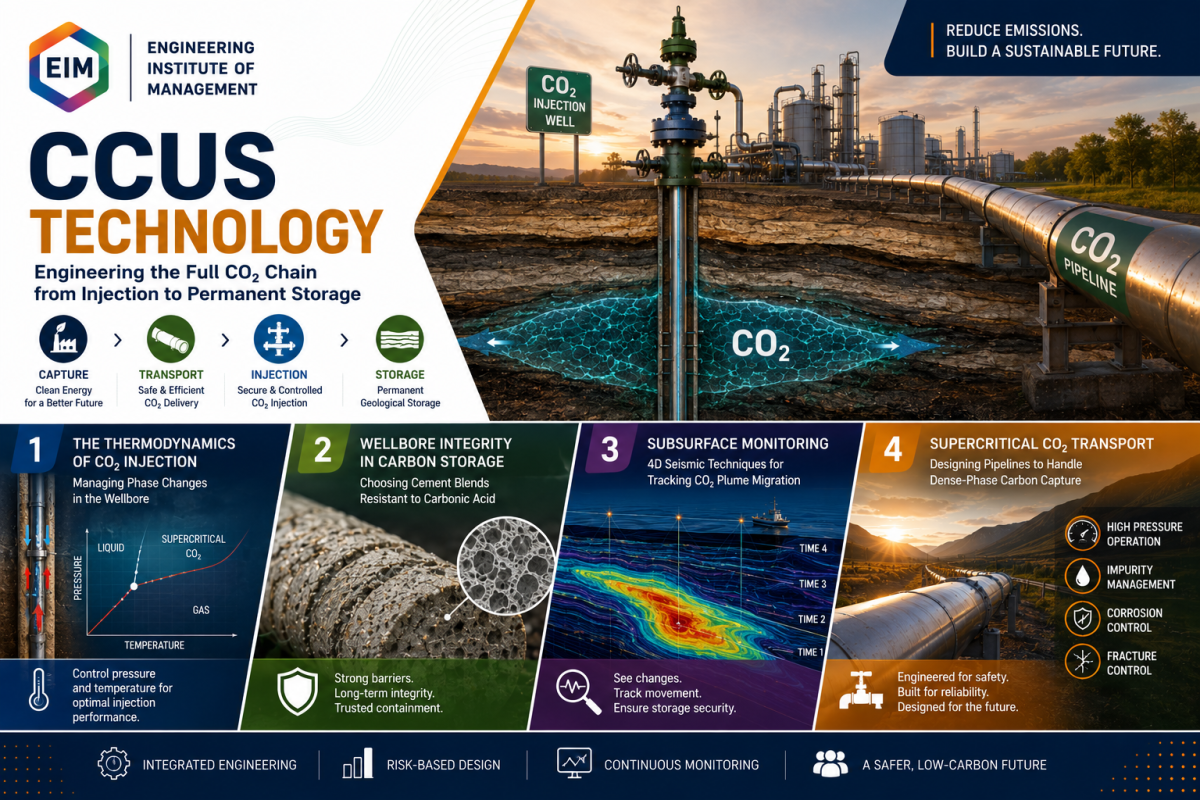
Carbon Capture, Utilization and Storage (CCUS) is developing into a complex engineering value chain that connects carbon capture facilities, compression systems, pipelines, injection wells and geological storage reservoirs.
While capturing CO₂ is an important part of the process, the long-term success of a CCUS project depends equally on what happens after capture: how CO₂ is compressed and transported, how it behaves during injection, how wells maintain integrity, and how engineers verify that the stored plume remains contained.
Four engineering challenges are particularly important:
- CO₂ injection thermodynamics: managing pressure, temperature and phase changes through the wellbore.
- Wellbore integrity: selecting cement systems that can withstand CO₂-rich fluids over long periods.
- Subsurface monitoring: using 4D seismic and other technologies to track CO₂ plume migration.
- Dense-phase CO₂ transport: designing pipelines that maintain safe and stable operating conditions.
Together, these challenges demonstrate that CCUS is not simply a carbon-management technology. It is a multidisciplinary engineering problem involving thermodynamics, fluid mechanics, materials science, geomechanics, well integrity, geophysics and pipeline engineering.
1. The Thermodynamics of CO₂ Injection: Managing Phase Changes in the Wellbore
One of the first engineering challenges begins when compressed CO₂ leaves the surface facilities and travels through the injection well toward the storage formation.
Pure CO₂ has a critical temperature of approximately 31.1°C and a critical pressure of approximately 7.38 MPa. Above both critical conditions, CO₂ exists as a supercritical fluid.
Supercritical CO₂ is attractive for geological storage because it can combine relatively high density with fluid-like mobility. However, engineers cannot simply assume that CO₂ will remain in exactly the same phase throughout the entire injection system.
Why Can the CO₂ Phase Change?
As CO₂ moves down an injection well, its pressure and temperature change continuously.
Important variables include:
- Wellhead pressure
- Injection temperature
- Injection rate
- Well depth
- Geothermal gradient
- Tubing diameter
- Fluid friction
- Heat transfer through tubing, casing and cement
- Reservoir pressure
- CO₂ composition and impurities
These variables determine the pressure-temperature path followed by the CO₂.
Recent modeling work shows that injection temperature can materially affect the phase reached by CO₂ at the reservoir. In some modeled cases, warmer injected CO₂ reached the reservoir in a supercritical state, while colder injection conditions produced liquid CO₂ near the well before transitioning farther into the formation. :contentReference[oaicite:0]{index=0}
Why Phase Management Matters
Phase changes can alter:
- CO₂ density
- Viscosity
- Compressibility
- Flow velocity
- Pressure drop
- Injectivity
- Buoyancy
- Thermal behavior
- Reservoir pressure distribution
For this reason, injection engineers need to understand the complete pressure-temperature trajectory rather than considering only the surface or bottom-hole conditions.
Joule-Thomson Effects and Near-Wellbore Cooling
CO₂ injection can also produce significant temperature changes near the wellbore. Pressure reduction and fluid expansion can produce cooling, while heat exchange with the surrounding formation gradually changes the temperature farther from the well.
Research on CO₂ injection shows that near-wellbore temperature behavior can be influenced by the Joule-Thomson effect, water vaporization and heat exchange with the formation. As CO₂ moves farther into the reservoir, it can gradually approach the surrounding rock temperature. :contentReference[oaicite:1]{index=1}
This is important because temperature changes can influence both fluid properties and mechanical stresses around the injection well.
Engineering Controls for Injection Thermodynamics
Engineers can manage the injection system through:
- Controlled CO₂ injection temperature
- Pressure management
- Injection-rate optimization
- Tubing and wellbore thermal modeling
- Reservoir simulation
- Accurate fluid-property models
- Monitoring of bottom-hole pressure and temperature
- Management of CO₂ impurities
The objective is to maintain a predictable operating envelope and avoid undesirable two-phase behavior where it could compromise injectivity, flow assurance or equipment performance.
2. Wellbore Integrity in Carbon Storage: Choosing CO₂-Resistant Cement
The injection well is one of the most important containment barriers in a geological CO₂ storage project.
A typical well contains multiple components, including:
- Steel casing
- Cement sheath
- Tubing
- Completion equipment
- Formation rock
The cement sheath plays a critical role in providing zonal isolation and preventing unwanted fluid migration behind casing.
The U.S. Department of Energy's National Energy Technology Laboratory identifies wellbore integrity as a critical area of carbon-storage research, including improved construction materials, leakage detection, remediation and long-term assessment. :contentReference[oaicite:2]{index=2}
How Does CO₂ Affect Cement?
When CO₂ dissolves in water, it can form carbonic acid:
CO₂ + H₂O ⇌ H₂CO₃
The resulting CO₂-rich aqueous environment can react with cement phases.
Depending on pressure, temperature, water availability and exposure conditions, cement can undergo processes including:
- Carbonation
- Decalcification
- Dissolution
- Leaching
- Changes in porosity
- Changes in permeability
- Interface alteration
- Potential debonding and leakage-path development
However, the interaction is more complicated than simply saying that CO₂ always “destroys” cement.
Experimental studies have shown that carbonation can produce calcium carbonate and, under some conditions, reduce porosity and permeability. Other experiments, particularly involving CO₂-saturated water and specific interfaces, have observed dissolution and increased porosity. The outcome depends strongly on the phase of CO₂ and the water chemistry. :contentReference[oaicite:3]{index=3}
Why Cement Selection Matters
A cement formulation suitable for a conventional oil or gas well should not automatically be assumed to be optimal for a long-term CO₂ storage well.
Modern research is investigating:
- Modified Portland cement systems
- Pozzolanic blends
- Calcium aluminate cement
- Calcium aluminate phosphate cement
- Magnesium phosphate systems
- Geopolymers
- Nano-engineered cement
- Polymer-enhanced systems
- Self-healing cement technologies
A 2026 review of CO₂-storage cement systems highlights calcium aluminate, calcium aluminate phosphate and magnesium phosphate systems among alternatives showing promising resistance in laboratory comparisons, while emphasizing that long-term field validation remains important. :contentReference[oaicite:4]{index=4}
What Should Engineers Evaluate?
Cement selection should consider more than compressive strength.
Important parameters include:
- Compressive strength retention
- Permeability
- Porosity
- Bond strength
- Thermal stability
- CO₂ exposure resistance
- Resistance to carbonic-acid-rich fluids
- Elastic properties
- Crack resistance
- Compatibility with casing and formation
- Long-term chemical stability
Recent reviews emphasize that CO₂-rich environments can cause carbonation, leaching, microcracking and permeability changes, making cement formulation and long-term testing central to well integrity. :contentReference[oaicite:5]{index=5}
The Cement–Casing–Formation Interfaces
One of the most important integrity considerations is that the cement itself is not the only concern.
Potential leakage pathways can develop along:
- Cement–casing interfaces
- Cement–formation interfaces
- Microannuli
- Existing fractures
- Cement channels
- Thermally or mechanically induced cracks
Experimental research has specifically identified the importance of cement–steel and cement–rock interfaces when evaluating CO₂-induced alteration. :contentReference[oaicite:6]{index=6}
Therefore, well integrity should be treated as a system-level problem, not simply a cement-strength problem.
3. Subsurface Monitoring: Using 4D Seismic to Track CO₂ Plume Migration
Once CO₂ is injected underground, engineers need to understand where it goes.
This is where Monitoring, Verification and Accounting (MVA) becomes essential.
NETL describes subsurface monitoring as a set of technologies used to map CO₂ plumes, document changes in subsurface properties and identify potential migration pathways. These technologies include seismic imaging, well logging, downhole monitoring, fluid sampling, tracer analysis, gravity and electrical methods. :contentReference[oaicite:7]{index=7}
What Is 4D Seismic?
4D seismic is essentially time-lapse 3D seismic.
A baseline seismic survey is acquired before or near the beginning of injection. Additional surveys are then acquired at later times.
By comparing the surveys, engineers can identify changes associated with CO₂ movement.
The basic concept is:
Baseline 3D Seismic + Repeat 3D Surveys = 4D Seismic Monitoring
Why Does CO₂ Produce a Seismic Signal?
Replacing formation brine with CO₂ changes the acoustic properties of the reservoir.
This can alter:
- Seismic velocity
- Acoustic impedance
- Reflection amplitude
- Travel time
- Seismic attributes
These changes can allow geophysicists to identify the evolving CO₂ plume.
The Sleipner Example
The Sleipner storage project in the Norwegian North Sea is one of the best-known demonstrations of time-lapse seismic monitoring for geological CO₂ storage.
CO₂ has been injected into the Utsira Formation since 1996, with repeated seismic surveys used to observe plume migration.
Time-lapse seismic data showed distinct high-reflectivity layers associated with CO₂ accumulations beneath internal shale layers. :contentReference[oaicite:8]{index=8}
More recent work continues to use advanced 4D seismic interpretation and inversion techniques to better understand plume boundaries, velocity changes and the influence of geological heterogeneity. :contentReference[oaicite:9]{index=9}
What Can 4D Seismic Tell Engineers?
4D seismic can help investigate:
- Plume location
- Plume migration direction
- Vertical plume movement
- Lateral spreading
- Interaction with geological barriers
- Changes in reservoir properties
- Potential unexpected migration
- Model-to-observation differences
But 4D Seismic Is Not Enough by Itself
Seismic monitoring provides indirect information. Interpretation depends on seismic quality, reservoir properties, acquisition repeatability, processing and geological understanding.
Therefore, a robust monitoring program can combine:
- 4D seismic
- Pressure monitoring
- Temperature monitoring
- Well logging
- Fluid sampling
- Tracers
- Microseismic monitoring
- Gravity monitoring
- Reservoir simulation
The goal is to create a multi-disciplinary picture of plume behavior rather than relying on one measurement technique.
4. Supercritical CO₂ Transport: Designing Pipelines for Dense-Phase Flow
Before CO₂ reaches the injection well, it often needs to travel significant distances from the capture facility to the storage site.
For large-scale CCUS projects, pipelines are expected to play a major role in connecting emission sources with storage hubs. DNV identifies CO₂ pipeline transport as a critical part of the CCS value chain and highlights fracture control, corrosion, flow assurance, impurity control and release consequences as key challenges. :contentReference[oaicite:10]{index=10}
Why Dense-Phase CO₂?
Transporting CO₂ at high pressure can produce a dense-phase fluid with much higher density than gaseous CO₂.
This can make pipeline transport more efficient because a larger mass of CO₂ can be transported through a given pipeline cross-section.
However, dense-phase CO₂ introduces its own engineering challenges.
The Importance of Pressure and Temperature
The pipeline must be designed and operated within an appropriate pressure-temperature envelope.
Pressure drops caused by friction, elevation and operating transients can move the CO₂ toward phase boundaries.
Engineers therefore need to understand:
- Pipeline pressure profile
- Temperature profile
- CO₂ density
- Viscosity
- Compressibility
- Phase envelope
- Flow rate
- Compressor performance
- Pressure-control strategy
IEAGHG research emphasizes that maintaining suitable operating conditions and minimizing two-phase flow are important considerations for CO₂ transport. :contentReference[oaicite:11]{index=11}
CO₂ Impurities Change the Design Problem
Captured CO₂ is rarely perfectly pure.
Depending on the capture process, the stream may contain impurities such as:
- N₂
- O₂
- H₂
- CH₄
- CO
- H₂S
- Water
- Other trace components
These impurities can change CO₂'s:
- Critical temperature
- Critical pressure
- Density
- Viscosity
- Phase behavior
- Compression requirements
- Pipeline capacity
- Fracture behavior
IEAGHG reports that impurities can significantly affect CO₂ thermodynamic and transport properties and can also influence pipeline material selection, corrosion, fracture control and operating conditions. :contentReference[oaicite:12]{index=12}
Water Is a Major Concern
Water management is particularly important in CO₂ pipelines.
Water can contribute to:
- Corrosion
- Hydrate formation
- Phase-behavior changes
- Operational instability
- Potential material degradation
Therefore, CO₂ dehydration and water-specification control are important parts of pipeline design.
Running Ductile Fracture
One of the most important safety challenges for dense-phase CO₂ pipelines is running ductile fracture.
A pipeline rupture can cause rapid depressurization and expansion of the CO₂. The decompression behavior of dense-phase CO₂ is different from that of conventional natural-gas systems, making fracture-control design particularly important.
DNV's CO₂ pipeline recommended practice addresses structural integrity, materials, design, construction, operation and requalification, while ongoing industry research continues to improve fracture-control models for dense-phase CO₂. :contentReference[oaicite:13]{index=13}
Repurposing Existing Pipelines
One potential way to accelerate CCUS infrastructure is to repurpose existing hydrocarbon pipelines.
However, a pipeline designed for natural gas cannot simply be assumed to be suitable for CO₂.
Requalification needs to consider:
- Original material grade
- Weld properties
- Fracture toughness
- Corrosion history
- Wall thickness
- Fatigue history
- Operating pressure
- CO₂ composition
- Impurity levels
- Water content
- Existing defects
DNV has specifically developed guidance and research programs addressing the requalification of existing pipelines for CO₂ service. :contentReference[oaicite:14]{index=14}
How the Four Engineering Challenges Connect
These four topics should not be considered isolated engineering problems.
| CCUS Stage | Primary Engineering Challenge | Key Technologies |
|---|---|---|
| CO₂ Transport | Maintaining stable dense-phase conditions | Thermodynamic modeling, flow assurance, pipeline simulation |
| Injection | Managing pressure and temperature changes | Wellbore thermal modeling, P-T monitoring, reservoir simulation |
| Well Integrity | Maintaining long-term containment | CO₂-resistant cement, integrity evaluation, logging |
| Storage Monitoring | Tracking plume migration | 4D seismic, pressure monitoring, well logging, tracers |
A change at one point in the chain can influence the others.
For example, CO₂ composition affects pipeline phase behavior. The same CO₂ composition enters the injection system and can influence wellbore thermodynamics and cement exposure. Injection pressure influences reservoir behavior, while reservoir behavior determines how the plume migrates and how monitoring systems interpret it.
This is why CCUS requires a systems-engineering approach.
CCUS Asset Integrity: A Systems Approach
A successful CCUS project should consider integrity across the entire chain:
Capture → Compression → Transport → Injection → Storage → Monitoring → Verification
At each stage, engineers need to understand the relevant failure mechanisms.
Pipeline Integrity
- Corrosion
- Fracture
- Fatigue
- Impurity-related degradation
- Pressure excursions
Well Integrity
- Cement degradation
- Microannulus formation
- Casing corrosion
- Thermal stress
- Pressure cycling
- Leakage pathways
Reservoir Integrity
- Caprock integrity
- Fault reactivation
- Pressure buildup
- Unexpected plume migration
- Induced seismicity
Monitoring Integrity
- Data quality
- Baseline accuracy
- Repeatability
- Model uncertainty
- Detection limits
The Role of Digital Technologies in CCUS
CCUS projects generate large quantities of engineering and monitoring data.
This creates opportunities for digital technologies such as:
- Digital twins
- Reservoir simulation
- Machine learning
- Real-time monitoring
- Cloud-based data platforms
- AI-assisted seismic interpretation
- Predictive maintenance
- Automated anomaly detection
Digital models can connect pipeline behavior, well conditions and reservoir response into a more integrated operating picture.
However, digital models should complement engineering judgment rather than replace it. Model predictions always contain assumptions and uncertainties that must be understood by the engineering team.
What Should Oil & Gas Engineers Learn for the CCUS Era?
CCUS creates opportunities for professionals from several traditional oil and gas disciplines.
Drilling and Well Engineers
- CO₂ injection well design
- Wellbore thermal behavior
- Injection pressure management
- Completion design
- Well integrity
Corrosion and Materials Engineers
- CO₂ corrosion
- Material compatibility
- Cement chemistry
- Pipeline corrosion
- Impurity effects
- Coating and materials selection
Reservoir Engineers
- CO₂ plume modeling
- Injectivity
- Pressure management
- Geological trapping
- Reservoir simulation
Geophysicists
- 4D seismic
- Seismic inversion
- Plume interpretation
- Geological modeling
- Monitoring uncertainty
Pipeline Engineers
- Dense-phase CO₂ flow
- Fracture control
- Flow assurance
- Pipeline requalification
- Impurity management
- CO₂ pipeline materials
The Future of CCUS Engineering
The future of CCUS will require more than simply increasing capture capacity.
The industry will need to develop an integrated infrastructure capable of safely handling CO₂ from the point of capture to permanent geological storage.
This means improving:
- CO₂ compression
- Pipeline infrastructure
- Injection-well design
- CO₂-resistant cement
- Reservoir characterization
- Plume monitoring
- Leakage detection
- Digital asset management
- Risk-based integrity management
Standards and recommended practices are also evolving as the industry develops. DNV's current CCS guidance includes recommended practices covering CO₂ pipelines and geological storage, while ongoing research is addressing emerging issues such as fracture control and pipeline requalification. :contentReference[oaicite:15]{index=15}
Conclusion
CCUS is often described as a climate technology, but its successful implementation depends heavily on engineering fundamentals.
The thermodynamics of CO₂ determine how the fluid behaves during transport and injection. Cement chemistry determines how wellbores respond to long-term CO₂ exposure. Subsurface geophysics helps engineers understand where the injected plume is moving. Pipeline engineering ensures that dense-phase CO₂ can be transported safely from capture facilities to storage sites.
These disciplines are interconnected.
The future CCUS engineer therefore needs to think beyond individual equipment or disciplines and understand the complete chain:
Capture → Compress → Transport → Inject → Store → Monitor → Verify
The ultimate objective is not simply to put CO₂ underground.
It is to demonstrate that the CO₂ can be transported safely, injected predictably, contained securely and monitored throughout its storage lifecycle.
For oil and gas professionals, this creates a significant opportunity to transfer decades of expertise in well integrity, pipeline engineering, corrosion control, reservoir management, geophysics and asset integrity into the growing CCUS sector.
Key Takeaways
- CO₂ can experience significant pressure and temperature changes between the surface, wellbore and reservoir.
- Injection temperature, pressure, rate and impurities can influence CO₂ phase behavior and injectivity.
- Wellbore integrity is a critical containment barrier in geological CO₂ storage.
- CO₂-rich water can alter cement through carbonation, dissolution, leaching and other reactions depending on conditions.
- Advanced cement systems, including pozzolanic, calcium-aluminate, magnesium-based and geopolymer systems, are being investigated for CO₂ storage wells.
- 4D seismic provides an important tool for tracking changes associated with CO₂ plume migration.
- Dense-phase CO₂ pipelines require careful control of pressure, temperature, impurities and water content.
- Fracture control is a major consideration for high-pressure CO₂ pipeline systems.
- Repurposing existing pipelines requires detailed technical requalification rather than simple conversion.
- The future of CCUS depends on integrating pipeline, well, reservoir, monitoring and asset-integrity engineering.