Corrosion & Asset Integrity: 4 Emerging Technologies and Techniques Every Oil & Gas Engineer Should Know
Explore four emerging approaches transforming corrosion and asset integrity management in oil & gas: MIC control, self-healing coatings, cathodic protection modeling, and advanced NDT techniques such as PAUT and radiography.
By Syed Hasan10 Sept 20268 min read
The oil and gas industry operates complex assets in some of the most demanding environments. Pipelines, offshore platforms, pressure vessels, storage tanks and process equipment are continuously exposed to conditions that can accelerate material degradation.
Modern asset integrity management is therefore moving beyond traditional inspection and corrosion-control methods. Engineers are increasingly combining microbiological analysis, advanced coatings, cathodic protection modeling, digital technologies and advanced non-destructive testing (NDT) to improve reliability and extend asset life.
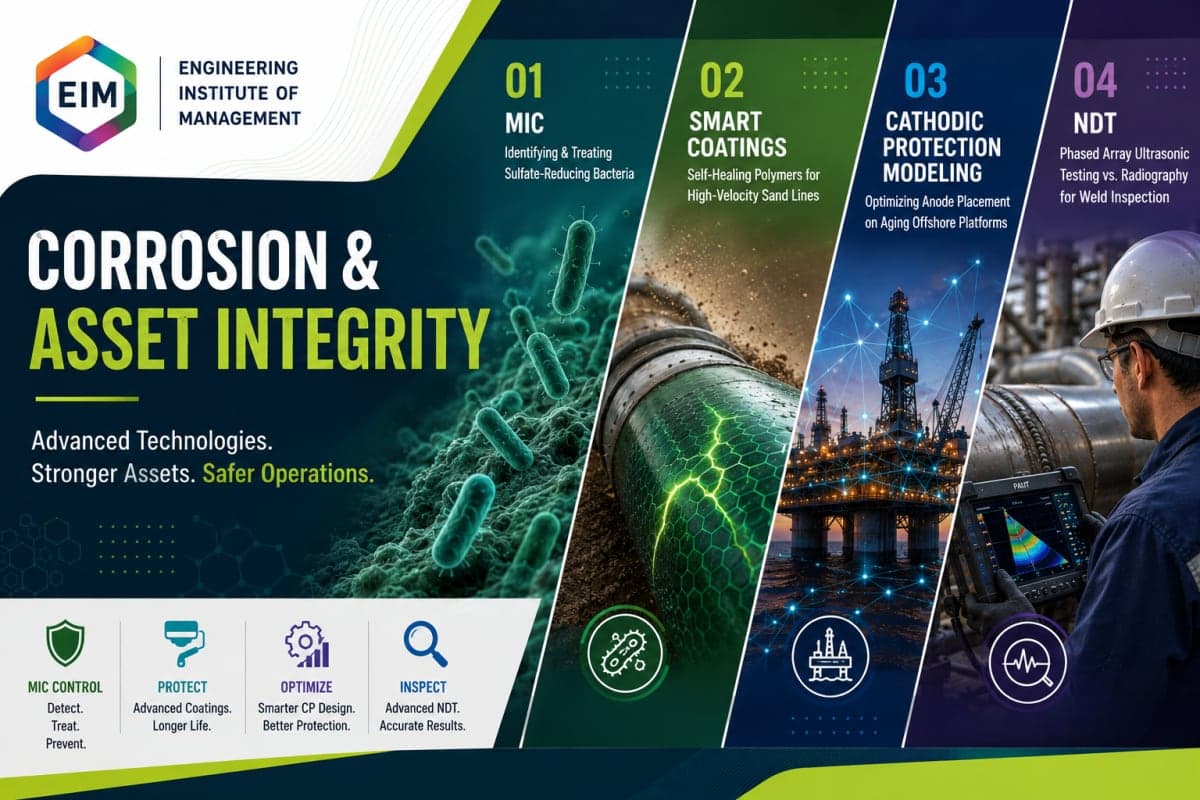
This article examines four important developments in corrosion and asset integrity:
- Microbiologically Influenced Corrosion (MIC) and sulfate-reducing bacteria
- Next-generation self-healing coatings for severe erosion environments
- Cathodic protection modeling for aging offshore platforms
- Phased Array Ultrasonic Testing (PAUT) vs. Radiography for weld inspection
1. Microbiologically Influenced Corrosion (MIC)
Microbiologically Influenced Corrosion, commonly known as MIC, occurs when microorganisms influence the corrosion behavior of metals. Microorganisms can alter the chemical and electrochemical conditions at a metal surface and accelerate localized corrosion.
Sulfate-Reducing Bacteria (SRB) are among the most widely studied microorganisms associated with MIC in oil and gas systems. Under suitable anaerobic conditions, SRB can contribute to sulfide production and create localized environments that promote corrosion.
Where Can MIC Become a Problem?
- Production pipelines
- Water-injection systems
- Storage tanks
- Offshore structures
- Process-water systems
- Separators
- Dead legs and stagnant areas
- Under-deposit regions
- Buried pipelines
How Is MIC Identified?
MIC should not be diagnosed simply because microorganisms are detected. A reliable assessment normally combines multiple lines of evidence.
- Microbiological testing
- Water chemistry
- Corrosion-product analysis
- Metallurgical examination
- Deposit and biofilm investigation
- Corrosion-rate data
- Inspection results
- Operating history
The key principle is that microbial detection alone does not prove MIC. Corrosion engineers need to connect microbiological evidence with physical corrosion evidence and eliminate alternative mechanisms.
MIC Mitigation
Depending on the operating environment and confirmed mechanism, mitigation may include:
- Water-quality management
- Biocide treatment
- Cleaning and pigging
- Deposit control
- Corrosion inhibitors
- Microbiological monitoring
- Corrosion-rate monitoring
- Improved drainage and flow conditions
- Appropriate materials and coatings
2. Next-Generation Smart Coatings and Self-Healing Polymers
Protective coatings form an important barrier between metal surfaces and aggressive environments. However, coatings can be damaged by mechanical impact, abrasion, particle erosion, sand production, temperature cycling and chemical exposure.
Once a coating becomes damaged, exposed metal can become vulnerable to corrosion.
This has encouraged research into smart and self-healing coatings.
How Do Self-Healing Coatings Work?
Self-healing polymers are designed to repair or partially restore their protective properties after damage.
There are two broad approaches:
Intrinsic Self-Healing
The polymer contains reversible chemical or physical interactions that allow the material to recover after damage.
Extrinsic Self-Healing
The coating contains healing agents stored in capsules, microvascular systems or other structures that can be released when damage occurs.
Why Are Self-Healing Coatings Interesting for Oil & Gas?
Consider a high-velocity sand-production line. Produced fluids containing sand particles can create severe erosion and mechanical damage. Conventional coatings may eventually develop cracks, defects or localized wear.
A self-healing coating could potentially reduce the impact of smaller damage events by restoring part of its protective function before corrosion becomes established.
However, these coatings should not be treated as a universal replacement for conventional coating systems.
Important engineering considerations include:
- Temperature limitations
- Pressure and chemical compatibility
- Erosion resistance
- Healing speed
- Number of healing cycles
- Mechanical strength
- Long-term durability
- Substrate compatibility
- Field application and repairability
For oil and gas applications, the challenge is moving promising laboratory technologies toward proven, durable and economically viable field solutions.
3. Cathodic Protection Modeling for Aging Offshore Platforms
Offshore structures face an aggressive corrosion environment because of continuous exposure to seawater, dissolved oxygen, marine organisms, temperature variations and other environmental factors.
Cathodic Protection (CP) is therefore an important component of offshore corrosion-control strategies.
Why Does Anode Placement Matter?
Effective cathodic protection is not simply a matter of installing as many anodes as possible. Engineers must consider the structure's geometry, environment, coating condition and current requirements.
Important design factors include:
- Structure geometry
- Seawater resistivity
- Coating condition
- Current demand
- Design life
- Anode material
- Anode capacity
- Current distribution
- Electrical continuity
- Environmental conditions
Why Modeling Is Valuable for Aging Platforms
For an aging offshore platform, the original cathodic protection design may no longer represent the current condition of the structure.
Over time:
- Coatings deteriorate
- Anodes are consumed
- Structural components may be modified
- New equipment may be installed
- Marine exposure conditions can change
- Electrical continuity can be affected
Numerical modeling can help engineers understand current distribution across complex structures and identify areas where protection may be insufficient.
A Simplified CP Modeling Workflow
Asset Geometry → Environmental Conditions → Material & Coating Data → Current Demand → Anode Placement → Current Distribution Modeling → Verification → Optimization
The objective is to achieve adequate protection without unnecessarily increasing anode quantity, weight or cost.
4. NDT: Phased Array Ultrasonic Testing vs. Radiography
Weld integrity is fundamental to the reliability of pipelines, pressure vessels, storage systems and offshore structures.
Two important volumetric NDT approaches are Phased Array Ultrasonic Testing (PAUT) and Radiographic Testing (RT).
Phased Array Ultrasonic Testing
PAUT uses multiple ultrasonic elements that can be electronically controlled to steer and focus ultrasonic beams.
It can provide information about:
- Location of indications
- Depth
- Length
- Height
- Orientation
- Characterization of discontinuities
PAUT is particularly valuable when inspection teams need detailed information about the location and geometry of weld indications.
Radiographic Testing
Radiography uses X-rays or gamma radiation to produce an image of internal features within a weld.
Modern radiographic inspection can use both traditional film and digital detector technologies.
PAUT vs. Radiography
| Factor | PAUT | Radiography |
|---|---|---|
| Technology | Ultrasonic waves | X-rays or gamma rays |
| Output | Electronic scan/data representation | Radiographic image |
| Depth information | Strong capability | Less direct |
| Indication sizing | Can provide location and dimensional information | Primarily image-based interpretation |
| Radiation hazard | No ionizing radiation | Requires radiation safety controls |
| Data storage | Digital inspection data can be retained | Digital radiography enables digital storage |
| Inspection suitability | Highly dependent on technique and geometry | Highly dependent on exposure arrangement and geometry |
Neither technology is automatically better in every situation.
The appropriate inspection method depends on:
- Material
- Thickness
- Weld geometry
- Expected discontinuity type
- Accessibility
- Inspection objective
- Applicable code or standard
- Acceptance criteria
- Radiation-control requirements
In some applications, PAUT and radiography can complement each other rather than compete directly.
How These Technologies Fit Into Asset Integrity Management
These four technologies address different integrity challenges but support the same overall objective: preventing failures and maintaining safe, reliable assets.
| Technology | Primary Challenge | Potential Contribution |
|---|---|---|
| MIC Monitoring | Biological corrosion | Identification and mitigation of microbial corrosion activity |
| Self-Healing Coatings | Coating damage | Potential recovery of protective function after damage |
| CP Modeling | Under-protection | Improved anode placement and current distribution |
| PAUT / RT | Weld discontinuities | Detection and characterization of weld defects |
Together, these technologies support a broader asset integrity philosophy:
Prevent → Monitor → Detect → Assess → Mitigate → Verify
The Future of Corrosion & Asset Integrity
The future of asset integrity will increasingly combine traditional engineering methods with advanced materials, digital technologies and data-driven decision-making.
Engineers may increasingly work with:
- Digital corrosion monitoring
- AI-assisted inspection analysis
- Advanced NDT
- Digital twins
- Numerical CP modeling
- Smart coatings
- IoT sensors
- Remote inspection technologies
- Risk-Based Inspection systems
- Predictive analytics
The objective is not simply to detect damage after it has occurred. The long-term goal is to move toward predictive and risk-informed asset integrity management.
Skills Corrosion & Asset Integrity Engineers Need
The modern corrosion and asset integrity engineer needs more than knowledge of corrosion mechanisms.
Corrosion Engineering
- Corrosion mechanisms
- Materials selection
- Corrosion monitoring
- Corrosion inhibitors
- MIC
- Coatings
- Cathodic protection
Inspection
- Ultrasonic Testing
- PAUT
- TOFD
- Radiography
- Visual inspection
- Inspection planning
Asset Integrity
- Risk-Based Inspection
- Fitness-for-Service
- Remaining-life assessment
- Failure analysis
- Integrity Operating Windows
- Inspection data management
Digital Skills
- Data analytics
- Digital twins
- Numerical modeling
- AI-assisted inspection
- IoT monitoring
- Predictive analytics
Conclusion
Corrosion and asset integrity management are moving into a more technology-driven era.
MIC monitoring is helping engineers better understand biological contributions to corrosion. Self-healing coatings are opening new possibilities for protecting surfaces against damage. Cathodic protection modeling can support more informed corrosion-control strategies for aging offshore assets. Meanwhile, PAUT and advanced radiography continue to provide powerful tools for weld inspection.
None of these technologies eliminates the need for engineering judgement. Instead, they give engineers better information with which to make decisions.
The future of asset integrity can therefore be summarized as:
Better Materials + Better Monitoring + Better Inspection + Better Modeling + Better Engineering Decisions
For oil and gas professionals, the opportunity is clear: build strong fundamentals in corrosion and inspection while developing the digital and analytical skills needed to manage increasingly complex assets.
The engineers who can connect corrosion science, inspection technology, asset integrity and digital tools will be well positioned to help the industry operate safer, longer and more efficiently.
Key Takeaways
- MIC requires biological, chemical, metallurgical and operational evidence for reliable assessment.
- Sulfate-reducing bacteria can contribute to corrosion under suitable environmental conditions.
- Self-healing polymer coatings are an emerging technology with potential applications in demanding oil and gas environments.
- Cathodic protection modeling can help optimize corrosion-control strategies for complex offshore structures.
- PAUT provides advanced ultrasonic capabilities for detecting and characterizing weld discontinuities.
- Radiography remains an important volumetric inspection method and continues to evolve through digital technologies.
- No single corrosion-control or NDT technology is universally superior; selection should be based on the asset, damage mechanism, geometry, applicable standards and inspection objective.
- The future of asset integrity will increasingly combine advanced materials, NDT, modeling, sensors, analytics and engineering judgement.