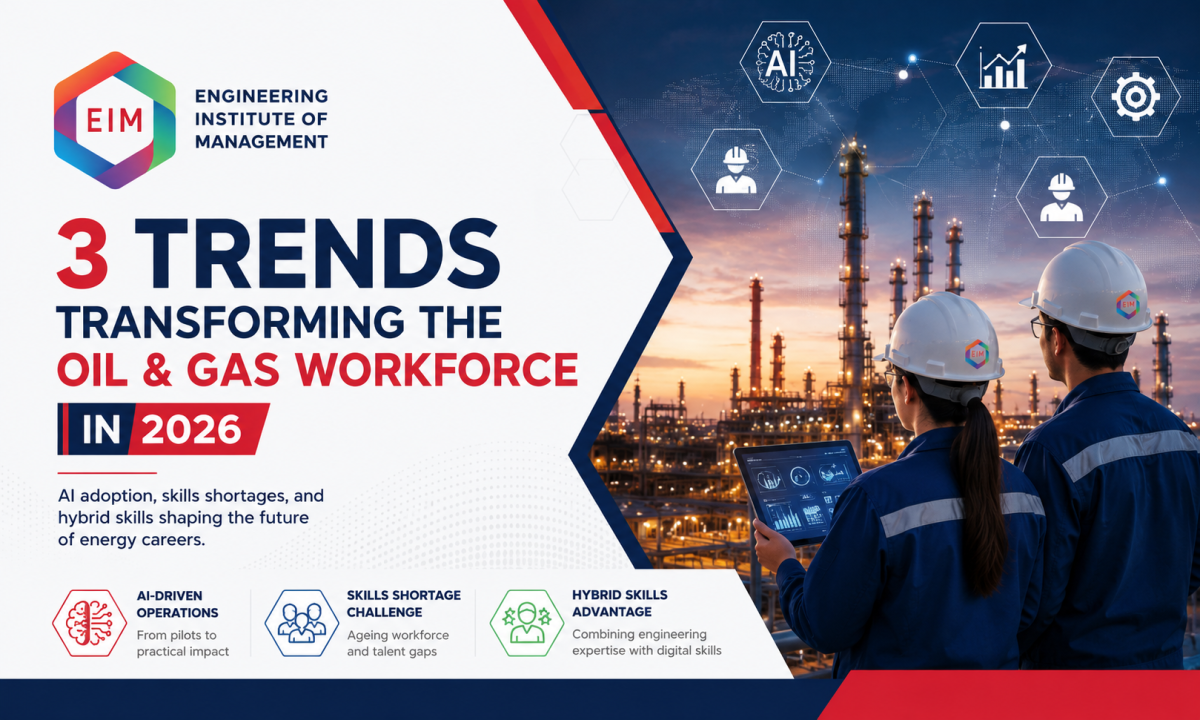
The oil and gas industry is entering a major workforce transformation. While technical expertise, operational experience and engineering fundamentals remain essential, the skills required to apply them are changing rapidly.
In 2026, oil and gas companies are simultaneously dealing with artificial intelligence, digital transformation, ageing workforces, technical skills shortages, automation and the broader energy transition.
The International Energy Agency (IEA) estimates that global energy employment reached approximately 76 million jobs in 2024, while more than half of surveyed energy companies reported critical hiring bottlenecks. This highlights an important challenge for the industry: technology is advancing rapidly, but skilled people remain essential.
For oil and gas professionals, three workforce trends stand out in 2026.
1. AI Is Moving From Experimentation to Everyday Engineering Work
Artificial intelligence has been discussed in the energy industry for years. What is changing in 2026 is the movement from small-scale AI experiments toward practical operational applications.
Oil and gas companies are increasingly exploring AI, machine learning, generative AI and advanced analytics across the value chain, including exploration, drilling, production, maintenance, inspection and asset management.
AI is increasingly being applied to:
- Predictive maintenance
- Production optimization
- Drilling analysis
- Equipment monitoring
- Computer-vision inspection
- Failure prediction
- Digital twins
- Technical document analysis
- Asset integrity management
- Safety and risk management
For example, predictive analytics can analyze historical and real-time equipment data to identify patterns associated with potential failures. Similarly, AI-assisted inspection technologies can help engineers process large volumes of inspection information more efficiently.
AI Is Not Replacing Engineering Expertise
The future is more likely to be Engineer + AI rather than Engineer vs. AI.
Engineers still need to understand the asset, evaluate uncertainty, challenge incorrect outputs and make responsible technical decisions.
This makes AI literacy an increasingly important skill for oil and gas professionals.
Professionals do not necessarily need to become machine-learning engineers. However, they should understand:
- What AI can and cannot do
- How to interpret AI-generated recommendations
- Data quality and limitations
- Basic data analytics
- Automation workflows
- Digital inspection technologies
- AI governance and cybersecurity
- How AI can support engineering workflows
The professionals who can combine engineering knowledge with digital technology will increasingly have an advantage in the job market.
2. The Skills Shortage Is Becoming a Strategic Risk
Technology may be transforming the industry, but people remain one of its biggest constraints.
The IEA's World Energy Employment 2025 report found that more than half of surveyed energy organizations reported critical hiring bottlenecks, with around 60% experiencing labour shortages.
The shortage is particularly important for applied technical occupations such as:
- Engineers
- Maintenance technicians
- Electricians
- Pipefitters
- Operations personnel
- Construction workers
- Equipment specialists
These professionals are responsible for operating, maintaining, inspecting and troubleshooting complex physical assets. Many of these tasks remain difficult to automate completely.
The Retirement and Knowledge-Transfer Challenge
The industry is also facing an ageing workforce.
According to the IEA, approximately two out of every three new energy hires through 2035 may be needed simply to replace retiring workers.
This creates a significant knowledge-transfer challenge.
An experienced inspection, corrosion, maintenance or asset integrity professional may have decades of practical knowledge about:
- Corrosion mechanisms
- Fatigue and cracking
- Erosion
- Creep
- Equipment degradation
- Failure mechanisms
- Inspection findings
- Field troubleshooting
This practical knowledge cannot always be transferred through textbooks or software.
Companies therefore need structured approaches to knowledge capture, mentoring and technical development.
Effective knowledge transfer can include:
- Mentoring programmes
- Technical communities
- Digital knowledge libraries
- Failure case studies
- Lessons-learned databases
- Expert-led training
- Simulation-based learning
- Structured competency programmes
The goal should be to create a clear pathway from:
Experienced Professional → Knowledge Transfer → Mentoring → Practical Training → Next-Generation Workforce
3. Hybrid Skills Are Becoming the New Competitive Advantage
The third major transformation is happening at the individual professional level.
Traditional engineering expertise remains the foundation, but professionals are increasingly expected to combine technical specialization with digital, analytical and sustainability-related capabilities.
The World Economic Forum's Future of Jobs Report 2025 estimates that around 39% of workers' existing skill sets are expected to be transformed or become outdated between 2025 and 2030.
Among the fastest-growing skill areas are AI and big data, networks and cybersecurity, and technological literacy.
For oil and gas professionals, this means developing a broader skill portfolio.
The Hybrid Oil & Gas Professional
A future-ready professional combines deep technical knowledge with complementary digital and business capabilities.
Inspection Engineer
Traditional skills:
- Inspection methods
- API standards
- Corrosion mechanisms
- Pressure equipment
- NDT
- Fitness-for-service
Future-oriented skills:
- Digital inspection platforms
- Risk-Based Inspection
- Data analytics
- Remote inspection technologies
- AI-assisted image analysis
- Asset integrity databases
Maintenance Engineer
Traditional skills:
- Preventive maintenance
- Troubleshooting
- Reliability
- Rotating equipment
- Mechanical systems
Future-oriented skills:
- Predictive analytics
- Condition monitoring
- Digital twins
- IoT sensors
- AI-assisted diagnostics
- Asset performance management
Corrosion Engineer
Traditional skills:
- Corrosion mechanisms
- Materials selection
- Corrosion monitoring
- Failure analysis
- Cathodic protection
Future-oriented skills:
- Digital corrosion monitoring
- Data interpretation
- Risk-Based Inspection
- Predictive corrosion analysis
- Environmental awareness
The objective is not to abandon traditional engineering knowledge. Instead, professionals should make that expertise more valuable by combining it with modern capabilities.
Green Skills and Digital Skills Are Converging
The workforce transformation is not being driven by AI alone.
The energy transition is creating another layer of skills requirements. The International Labour Organization highlights the growing importance of combining green skills and digital skills as industries respond to both transitions.
Oil and gas professionals may increasingly encounter areas such as:
- Carbon management
- Methane monitoring
- Energy efficiency
- Emissions reduction
- Electrification
- Hydrogen
- Carbon capture
- Environmental monitoring
- Digital energy systems
- Sustainability reporting
This does not mean every oil and gas engineer needs to become a renewable-energy specialist.
Instead, professionals should understand how their existing discipline connects with an evolving energy system.
What Does This Mean for Oil & Gas Companies?
The workforce challenge cannot be solved simply by hiring more people. Companies need to rethink how they develop, retain and deploy technical talent.
1. Move From Traditional Training to Continuous Skill Development
Training should no longer be viewed simply as:
Course → Certificate → Return to Work
A more effective model is:
Work → Learn → Apply → Measure → Improve → Learn Again
Technical development should be closely connected to real operational challenges and career progression.
2. Combine AI With Human Expertise
AI implementation should not be treated purely as an IT project. Engineers, inspectors, operators and maintenance professionals should participate in determining where AI can create value and where human judgement must remain essential.
3. Capture Institutional Knowledge
Organizations should create structured systems that allow experienced professionals to transfer knowledge to younger employees before that expertise is lost through retirement.
4. Develop Hybrid Career Paths
Companies can create career pathways that combine technical expertise with digital capabilities.
For example:
Inspection → RBI → Digital Inspection → Asset Integrity Analytics
or:
Maintenance → Reliability → Predictive Maintenance → AI-Enabled Asset Performance
What Should Oil & Gas Professionals Do in 2026?
For individual professionals, the workforce transformation creates both challenges and opportunities.
A practical strategy is to develop a T-shaped skill profile.
Build Deep Expertise in One Core Discipline
- Inspection
- Corrosion
- Asset Integrity
- Mechanical Engineering
- Process Engineering
- Maintenance
- Reliability
- HSE
- Operations
Then Add Complementary Skills
Digital: AI literacy, data analytics, automation and digital tools.
Standards: API, ASME, ISO and other relevant industry standards.
Business: Risk management, project management, cost awareness and decision-making.
Human skills: Communication, leadership, critical thinking, problem-solving and collaboration.
This combination can make professionals significantly more adaptable as job requirements evolve.
The Biggest Workforce Shift: From Job Titles to Skill Portfolios
One of the most important workforce changes is that careers are becoming less defined by a single job title.
An inspection engineer may increasingly work with computer vision and data analytics.
A corrosion engineer may analyze large operational datasets.
A maintenance engineer may work with AI-enabled predictive systems.
An operations engineer may interact with advanced digital control systems.
A project engineer may use digital twins and advanced simulation.
This means career resilience will increasingly depend on what you can do, rather than simply what your job title says.
The Oil & Gas Workforce of 2030 Starts With Decisions Made Today
The workforce of 2030 will not be created in 2030. It is being built today.
Companies that invest early in skills development, knowledge transfer, AI adoption and workforce capability will be better positioned to manage the technical complexity of the future.
For professionals, the message is equally clear:
Do not choose between technical expertise and digital skills. Build both.
Your engineering fundamentals remain your foundation. AI, analytics, automation and emerging technologies are tools that can extend that foundation.
The professionals most likely to thrive in the coming decade will be those who combine:
Engineering Expertise + Digital Literacy + Practical Experience + Continuous Learning + Human Judgement
Conclusion
Three forces are reshaping the oil and gas workforce in 2026:
1. AI is changing how work gets done.
Companies are moving toward AI-enabled operations, maintenance, inspection, analytics and decision support.
2. Skills shortages are becoming a strategic constraint.
Ageing workforces, retirement and insufficient technical talent are increasing pressure on companies to recruit, train and retain skilled professionals.
3. Hybrid skills are becoming the new competitive advantage.
The future professional will combine deep technical knowledge with digital, analytical, environmental and human capabilities.
The industry does not simply need more workers. It needs more adaptable workers.
And it does not simply need more technology. It needs people who know how to use technology safely, intelligently and effectively.
The future of oil and gas will ultimately be shaped by the combination of people, technology and expertise.
The organizations and professionals that start preparing today will be better positioned for the workforce demands of the next decade.
Key Takeaways
- Global energy employment reached approximately 76 million jobs in 2024.
- More than half of surveyed energy organizations reported critical hiring bottlenecks.
- Approximately two-thirds of new energy hires through 2035 may be required to replace retiring workers.
- AI is moving from experimentation toward operational applications.
- Digital technologies could create significant value across upstream oil and gas operations.
- Approximately 39% of workers' existing skill sets are expected to change or become outdated by 2030.
- Workforce development is becoming a strategic priority for oil and gas companies.
- Future competitiveness will depend on combining technical expertise with digital and human skills.