Drilling & Production Optimization: How Digital Technologies Are Transforming Upstream Oil & Gas
Discover how AI, real-time data, automation and digital twins are transforming drilling and production optimization in oil & gas, improving efficiency, reducing downtime and enabling smarter engineering decisions.
EIM Editorial Team27 Aug 20269 min read
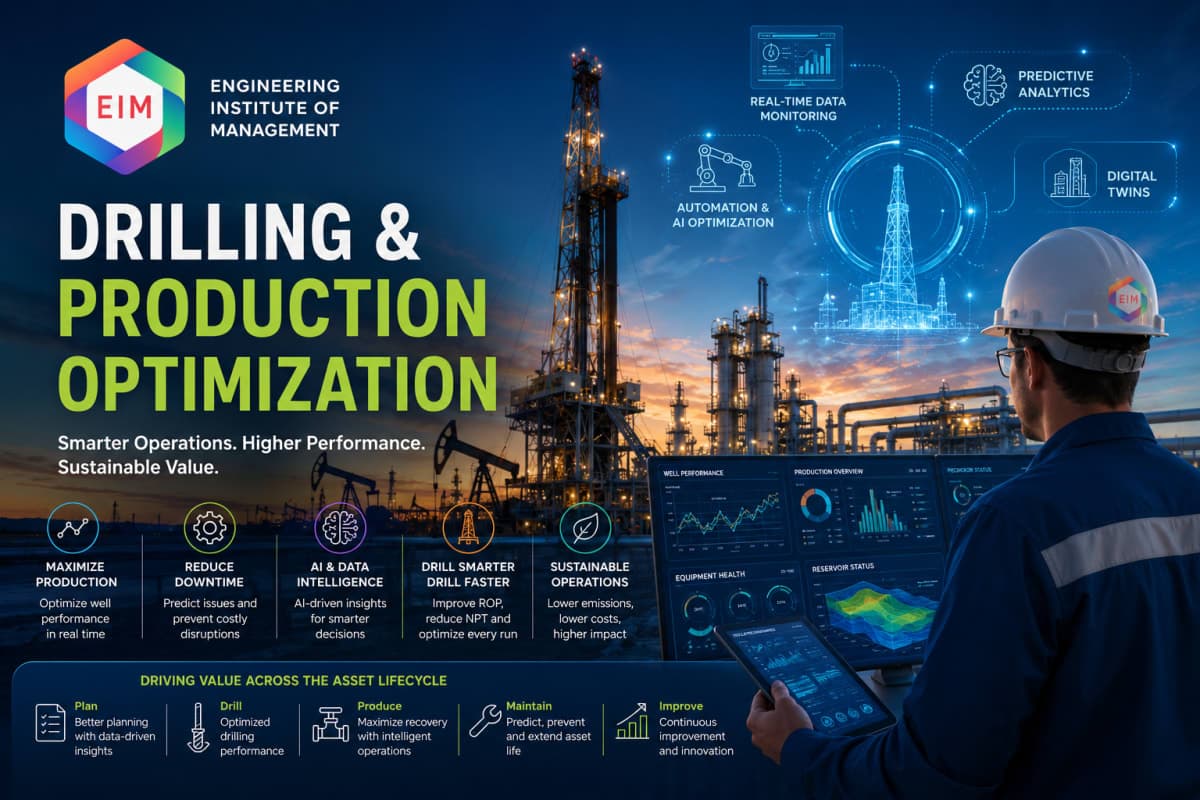
The upstream oil and gas industry is under constant pressure to drill faster, produce more efficiently, reduce downtime, control costs and improve safety. Traditional optimization relied heavily on engineering models, field experience and periodic operational reviews. Today, real-time data, artificial intelligence (AI), machine learning, automation and digital twins are changing how drilling and production decisions are made.
Drilling and production optimization is becoming a continuous process: collect data → analyze performance → identify opportunities → optimize operations → measure results.
What Is Drilling & Production Optimization?
Drilling and production optimization is the process of improving well and field performance while balancing production, cost, safety, equipment reliability and reservoir constraints.
During drilling, optimization may involve:
- Rate of penetration (ROP)
- Weight on bit (WOB)
- Rotary speed (RPM)
- Torque and drag
- Mud properties
- Well trajectory
- Hole cleaning
- Bit performance
- Tripping time
- Non-productive time (NPT)
During production, optimization can involve:
- Well operating conditions
- Artificial lift settings
- Choke management
- Gas-lift rates
- Pressure management
- Water and gas production
- Production allocation
- Equipment performance
- Reservoir conditions
The objective is not simply to produce more. It is to achieve the best sustainable performance within technical, economic and safety constraints.
1. Real-Time Data Is Becoming the Foundation of Optimization
Modern drilling and production operations generate enormous quantities of data. Sensors can continuously capture information about pressure, temperature, flow, vibration, torque, RPM, equipment condition and well performance.
Historically, much of this information was reviewed after an event or during periodic engineering studies. Modern digital operations increasingly allow engineers to analyze information as it is generated.
Real-Time Data → Analysis → Decision → Action
This creates a continuous optimization loop that can help engineers identify abnormal conditions, evaluate performance and adjust operating parameters before a small problem becomes a major operational issue.
2. AI Is Changing Drilling Optimization
Artificial intelligence and machine learning are increasingly being explored for drilling applications. Machine-learning models can analyze historical and real-time drilling data to identify relationships between operating conditions and drilling performance.
AI-based systems can support optimization of:
- Weight on bit
- Rotary speed
- Rate of penetration
- Mud parameters
- Directional drilling
- Drillstring behavior
- Hole cleaning
- Equipment performance
One advantage of AI is its ability to process large numbers of variables simultaneously. However, AI should support rather than replace engineering judgement.
The strongest optimization approaches combine data-driven analytics with physics-based engineering models. Engineers must still validate whether AI recommendations make physical and operational sense.
3. Drilling Automation Is Moving Toward Closed-Loop Operations
The next step beyond monitoring and analytics is automation.
Modern drilling systems can increasingly monitor operating conditions, provide recommendations and, in selected applications, automatically adjust operating parameters.
The progression can be viewed as:
Manual Operation → Digital Monitoring → Data-Driven Recommendations → Automated Control → Closed-Loop Optimization
This does not make drilling engineers unnecessary. Instead, their responsibilities increasingly move toward supervision, validation, exception management and higher-value technical decisions.
4. Production Optimization Is Becoming Continuous
Production optimization has traditionally involved well testing, engineering analysis and periodic adjustments. Digital technologies are enabling a more continuous approach.
Instead of asking, “How did this well perform last month?”, engineers can increasingly ask, “What is happening right now, and what should we change?”
Advanced analytics can support:
- Production forecasting
- Well performance analysis
- Anomaly detection
- Artificial lift optimization
- Choke optimization
- Pressure management
- Water-cut monitoring
- Gas-production optimization
- Equipment performance monitoring
This shift can help production teams respond faster to changing well and equipment conditions.
5. Artificial Lift Optimization Is a Major Opportunity
Artificial lift is an important area for production optimization because operating conditions can significantly affect both production and equipment life.
Common artificial lift systems include:
- Electric submersible pumps (ESPs)
- Gas lift
- Beam pumps
- Progressive cavity pumps
Digital monitoring and machine learning can help engineers evaluate operating conditions and identify opportunities for more efficient artificial-lift performance.
Potential benefits include:
- Higher sustainable production
- Improved pump performance
- Longer equipment life
- Lower energy consumption
- Fewer manual interventions
- Earlier detection of abnormal conditions
6. Digital Twins Are Connecting Drilling, Production and Asset Performance
A digital twin is a digital representation of a physical asset, system or process. In upstream operations, digital twins can combine real-time sensor data, historical operational data, engineering models, equipment information and AI-based analytics.
For drilling, digital twins can support:
- Well planning
- Trajectory optimization
- Equipment monitoring
- Predictive maintenance
- Drilling performance analysis
For production, they can support:
- Production forecasting
- Well optimization
- Equipment performance monitoring
- Reservoir management
- Scenario analysis
The value of a digital twin comes from connecting the physical operation with a continuously updated digital model.
7. Optimization Is Also About Reducing Non-Productive Time
Reducing Non-Productive Time (NPT) is one of the most important opportunities in drilling.
NPT can result from:
- Equipment failures
- Stuck pipe
- Lost circulation
- Unexpected geological conditions
- Excessive tripping time
- Poor hole cleaning
- Waiting for equipment or services
- Operational delays
Real-time monitoring can help identify abnormal trends in torque, drag, pressure, vibration, rate of penetration and pump performance.
Early detection gives drilling teams an opportunity to intervene before an issue develops into a major operational event.
8. Production Optimization Must Balance More Than Production
A common misconception is that optimization simply means increasing production.
In reality, production optimization is a multi-objective engineering problem.
Engineers may need to balance:
Production + Reservoir Constraints + Equipment Reliability + Energy Consumption + Operating Cost + Safety + Environmental Performance
For example, increasing a well's production rate may initially appear beneficial. However, if the higher rate causes excessive water production, rapid pressure decline, equipment stress or premature failure, the long-term result may be worse.
Effective optimization therefore considers the complete lifecycle of the asset, rather than focusing only on short-term production.
9. Data Quality Is One of the Biggest Challenges
Advanced analytics and AI are only as reliable as the data behind them.
Oil and gas companies often work with data from sensors, SCADA systems, well databases, maintenance systems, laboratory measurements and production allocation platforms.
If data is incomplete, inconsistent or incorrectly labeled, analytical models can produce misleading results.
This creates a fundamental principle:
Better Data → Better Analysis → Better Decisions
Before implementing sophisticated AI systems, companies should focus on:
- Data quality
- Data standardization
- Data governance
- System integration
- Cybersecurity
- Data accessibility
10. The Human Engineer Remains Critical
Automation can handle repetitive calculations and operational adjustments, but engineering judgement remains essential.
A production engineer needs to understand reservoir behavior, well constraints, fluid properties, equipment limitations and operating risks.
A drilling engineer needs to understand formation behavior, wellbore stability, drillstring mechanics, hydraulics, directional drilling and well-control principles.
AI can identify patterns, but engineers must determine whether those patterns make physical, technical and operational sense.
The future is therefore not:
AI replacing engineers
It is:
Engineers using AI to make better decisions faster.
Key Technologies Driving Drilling & Production Optimization
| Technology | Application |
|---|---|
| AI & Machine Learning | Prediction and optimization |
| Real-Time Analytics | Immediate operational decision support |
| Digital Twins | Asset and process modelling |
| IoT Sensors | Continuous data collection |
| Automation | Automated parameter adjustment |
| Edge Computing | Low-latency operational decisions |
| Cloud Computing | Large-scale data processing |
| Computer Vision | Visual monitoring and analysis |
| Predictive Maintenance | Failure prevention |
| Advanced Control Systems | Continuous optimization |
Benefits of Drilling & Production Optimization
Increased Production
Better operating conditions can improve well and field performance while maintaining technical constraints.
Reduced Drilling Time
Optimized drilling parameters and automation can improve drilling efficiency and reduce unnecessary delays.
Lower Non-Productive Time
Early anomaly detection can help prevent avoidable downtime and operational disruptions.
Improved Equipment Reliability
Predictive analytics can identify developing equipment problems before they result in major failures.
Better Decision-Making
Engineers can use real-time information to complement historical reports and engineering models.
Improved Safety
Remote monitoring and automation can reduce unnecessary human exposure to hazardous operating environments.
Lower Operating Costs
Better equipment utilization, reduced downtime and improved energy efficiency can contribute to lower operating expenditure.
What Does the Future Look Like?
The future of drilling and production optimization is moving toward integrated and increasingly autonomous operations.
The long-term concept can be represented as:
Sensors → Real-Time Data → AI & Physics-Based Models → Digital Twin → Optimization Engine → Automated Action → Performance Feedback
The system continuously evaluates operational results and uses those insights to improve future decisions.
Fully autonomous operations will require reliable data, robust engineering models, cybersecurity, clear governance and appropriate human oversight.
Skills Engineers Need for the Future
As upstream operations become increasingly digital, engineers will need to combine traditional technical expertise with digital capabilities.
Technical Skills
- Drilling engineering
- Production engineering
- Reservoir engineering
- Well integrity
- Artificial lift
- Well-control principles
- Completion engineering
Digital Skills
- Data analytics
- AI and machine-learning fundamentals
- Digital twins
- Automation
- Python or similar analytical tools
- Cloud and edge computing concepts
- Real-time monitoring systems
Human Skills
- Critical thinking
- Problem-solving
- Decision-making
- Communication
- Cross-functional collaboration
The most valuable professional will not necessarily be the person who knows the most about AI. It will be the engineer who understands both the technology and the physics of the asset.
Conclusion
Drilling and production optimization is evolving from a primarily experience-driven process into a data-driven, AI-assisted and increasingly automated discipline.
Real-time data is improving operational visibility. AI is helping identify patterns and optimization opportunities. Digital twins are connecting physical assets with digital models. Automation is reducing repetitive tasks, while predictive analytics can help identify developing problems before they become costly failures.
But technology alone will not deliver optimization.
Successful implementation requires the combination of:
High-Quality Data + Engineering Expertise + AI + Automation + Human Judgement
The future upstream operation will not simply be a smarter rig or a smarter well. It will be a connected, continuously improving and increasingly autonomous system in which engineers use technology to make faster, safer and more economically sound decisions.
For oil and gas professionals, the message is clear:
Understand the fundamentals. Learn the digital tools. Use data intelligently. And never lose the engineering judgement that makes optimization possible.
Key Takeaways
- Drilling optimization focuses on improving well construction while reducing cost, risk and NPT.
- Production optimization aims to maximize sustainable production while respecting reservoir and equipment constraints.
- Real-time data is becoming central to upstream decision-making.
- AI and machine learning are increasingly being applied to drilling and artificial-lift optimization.
- Digital twins can connect real-time operational data with engineering models.
- Automation is moving drilling and production toward continuous and increasingly autonomous optimization.
- Data quality, cybersecurity and engineering validation remain critical.
- The future engineer will combine domain expertise with digital and analytical skills.