Welcome to Excellence Integrity Management - Empowering Professionals Globally.
Home>Courses>Process Safety Engineering

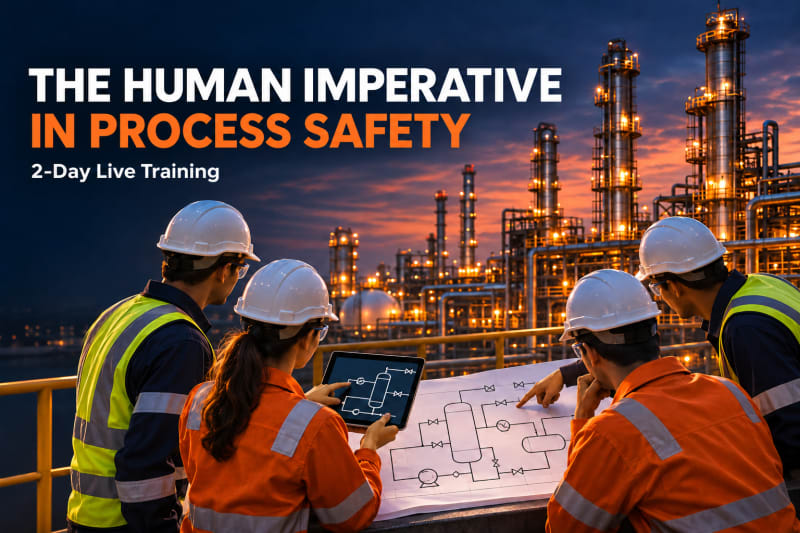
The Human Imperative in Process Safety

The Human Imperative in Process Safety

Engineering Excellence Beyond Compliance. A two-day live online programme, 25 and 26 November 2026.
5
37 Learners
2 Sessions
  • Live Instructor-Led Online Training
  • 2-Day Programme, 6 Hours
  • HAZID, HAZOP, QRA, LOPA & SIL
The Human Imperative in Process Safety
$100

Lessons

2

Rating

4.7 / 5.0

Students

37

Certificate

Included

Course Overview

The Human Imperative in Process Safety is a two-day live online programme on a simple idea: standards say what must exist, but people decide how well it works. It is built for engineers and project professionals who already know the studies and now want to understand why process safety still fails, and what to do about it.

The programme walks through safety studies across the project lifecycle (HAZID, HAZOP, QRA, LOPA, SIL, FERA and human factors), then looks at the real causes of major accidents such as Flixborough, Piper Alpha, Texas City, Buncefield and Deepwater Horizon. It closes with a practical framework of five pillars and an executive roadmap for moving an organisation from reactive to resilient.

Delivered by Chandan Chattopadhyay, PMP, who has more than 45 years of experience on refinery and petrochemical mega-projects, from FEED through EPC execution, commissioning and start-up. Live on 25 and 26 November 2026, six hours in total.
Course Objectives

  • Explain why process safety fails even where standards, procedures and audits are in place.
  • Describe what HAZID, HAZOP, QRA, LOPA, SIL and FERA each contribute across the project lifecycle.
  • Draw practical lessons from major accidents about barrier degradation, management of change and leadership.
  • Apply the five pillars of resilient process safety to your own site or project.
  • Recognise the weak signals that show safeguards are degrading before an incident.
  • Understand where AI and digital tools help, and why human judgement remains the final barrier.
  • Use the process safety maturity model to see where an organisation stands and what to do next.

Course Syllabus

Curriculum Designed by Experts

Part 1 – Safety Studies Across the Project Lifecycle

  • Process safety from conceptual design and FEED, through detailed engineering, to operations
  • HAZID and early qualitative studies: macro risk screening, plot layout, inter-unit spacing and checklist brainstorming
  • HAZOP, the core engineering review: guideword application, the multidisciplinary team and the actions that come out of it
  • QRA and consequence modelling: ALARP, individual and societal risk, toxic H2S dispersion, pool and flash fires, vapour cloud explosions
  • LOPA and safety integrity levels (SIL 1 to SIL 4): target risk reduction and typical applications
  • FERA and emergency survivability: fire protection sizing, ESSA and EERA, building risk assessment
  • Human factors engineering, bow-tie barrier mapping and RAM studies
  • The limits of engineering safeguards: why unforeseen failure combinations and degraded safeguards still happen

Part 2 – The Human Imperative

  • Why process safety still fails: engineering systems versus human and organisational factors
  • The evolution of process safety, and why standards are necessary but never sufficient
  • Lessons from Flixborough, Piper Alpha, Longford, Texas City, Buncefield and Deepwater Horizon
  • Barrier management, from design to major accident prevention
  • Where process safety begins: FEED, inherently safer design, relief philosophy, HAZOP and LOPA
  • Brownfield, commissioning, start-up and management of change
  • Twenty practical lessons for young engineers
  • The Human Imperative framework and the five pillars: sound engineering design, mechanical integrity, operational discipline, knowledge stewardship and visible leadership
  • Human judgement as the final effective barrier
  • Digital twins, AI and digital tools as decision support, not a replacement for judgement
  • Future challenges: energy transition, digitalisation, ageing assets and workforce change
  • Executive roadmap and process safety maturity, from reactive to resilient, with recommendations for industry

Meet Your Instructor

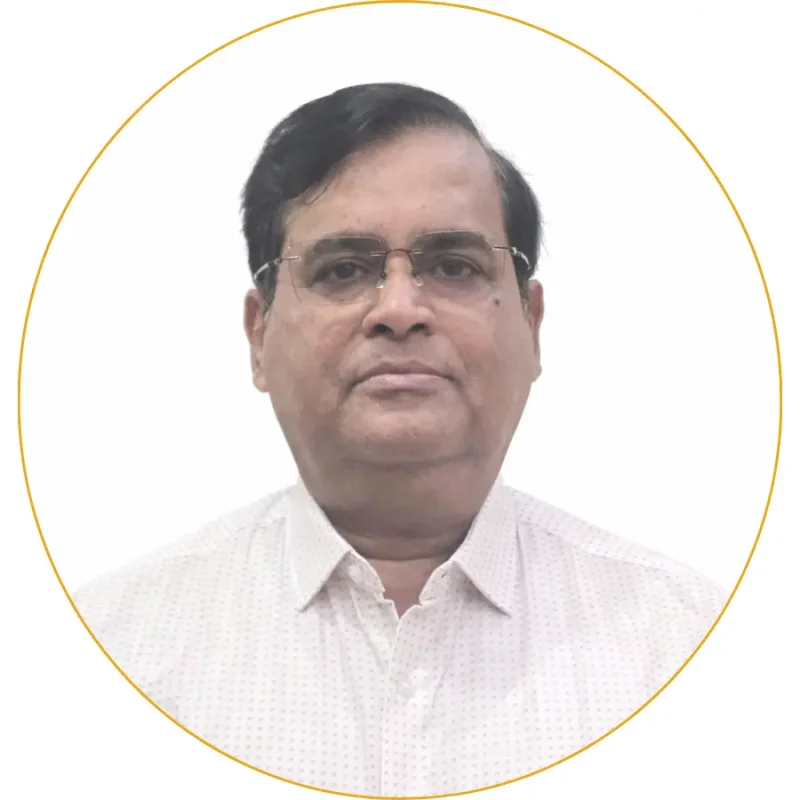
Mr. Chandan Chattopadhyay

Mr. Chandan Chattopadhyay

Senior Subject Matter Expert

15+ Years Experience
Instructor Bio: Mr. Chandan Chattopadhyay is a PMP-certified Chemical Engineer and Process & FEED Advisor with over 45 years of international experience in the oil, gas, refinery, and petrochemical industries. He has successfully led the end-to-end execution of multi-billion-dollar refinery and petrochemical mega projects, covering feasibility studies, FEED, detailed engineering, EPC execution, construction, commissioning, and start-up. Throughout his career, Mr. Chattopadhyay has managed international EPC contractors, technology licensors, and multidisciplinary engineering teams, consistently delivering complex projects on schedule and within budget. His expertise includes process engineering, project management, process design, value engineering, debottlenecking, plant revamps, and technical leadership for large-scale industrial facilities. He possesses extensive knowledge of process simulation, PFD and P&ID development, risk assessment studies including HAZOP, SIL, HAZID, ENVID, and QRA, as well as techno-economic evaluations, catalyst systems, technology selection, and project feasibility. He is proficient in industry-standard engineering software such as PRO-II, PROVISION, HYSYS, PIPENET, AutoCAD, and Microsoft Office Suite. As a trainer, Mr. Chattopadhyay combines decades of practical project experience with industry best practices, providing professionals with real-world insights into process engineering, FEED development, EPC project execution, and refinery and petrochemical operations.

Course Benefits

Live Instructor-Led Online Training
2-Day Programme, 6 Hours
HAZID, HAZOP, QRA, LOPA & SIL
Lessons from Major Accidents
Five Pillars of Resilient Safety
Barrier Management & MOC
Human Factors & Leadership
AI and Digital Tools as Decision Support
Executive Roadmap & Maturity Model

Process Safety Training for Your Team

Tailored to your site

The studies, case histories and discussion adapted to your facility, project stage or operating context.

Experienced instructor

Delivered by a process and FEED adviser with more than 45 years on refinery and petrochemical projects.

Leadership and engineers together

A format that lets managers and engineers work through the same barriers and decisions.

Online or on site

Delivered online or at your location, to suit your team and schedule.

Frequently Asked Questions

Instructor-led Training Live Online Classes

Course Price At
$100
Secure Transaction

This Course Includes

  • Live Instructor-Led Online Training
  • 2-Day Programme, 6 Hours
  • HAZID, HAZOP, QRA, LOPA & SIL
  • Lessons from Major Accidents
  • Five Pillars of Resilient Safety
  • Barrier Management & MOC
  • Human Factors & Leadership
  • AI and Digital Tools as Decision Support
  • Executive Roadmap & Maturity Model

Free Career Counselling

We are happy to help you 24/7

Share this Course
Why Attend The Human Imperative in Process Safety?

Most major accidents did not happen because a standard was missing. They happened because barriers decayed, changes were not reviewed, production pressure won, and weak signals were not acted on. This two-day programme shows how safety studies, mechanical integrity, operational discipline, knowledge stewardship and visible leadership work together.

You will see how HAZID, HAZOP, QRA, LOPA, SIL and FERA fit into the project lifecycle, learn from Flixborough, Piper Alpha, Texas City, Buncefield and Deepwater Horizon, and leave with a practical roadmap for moving from reactive to resilient safety. It is aimed at engineers, project teams, operations and safety professionals and managers in oil and gas and petrochemical companies.