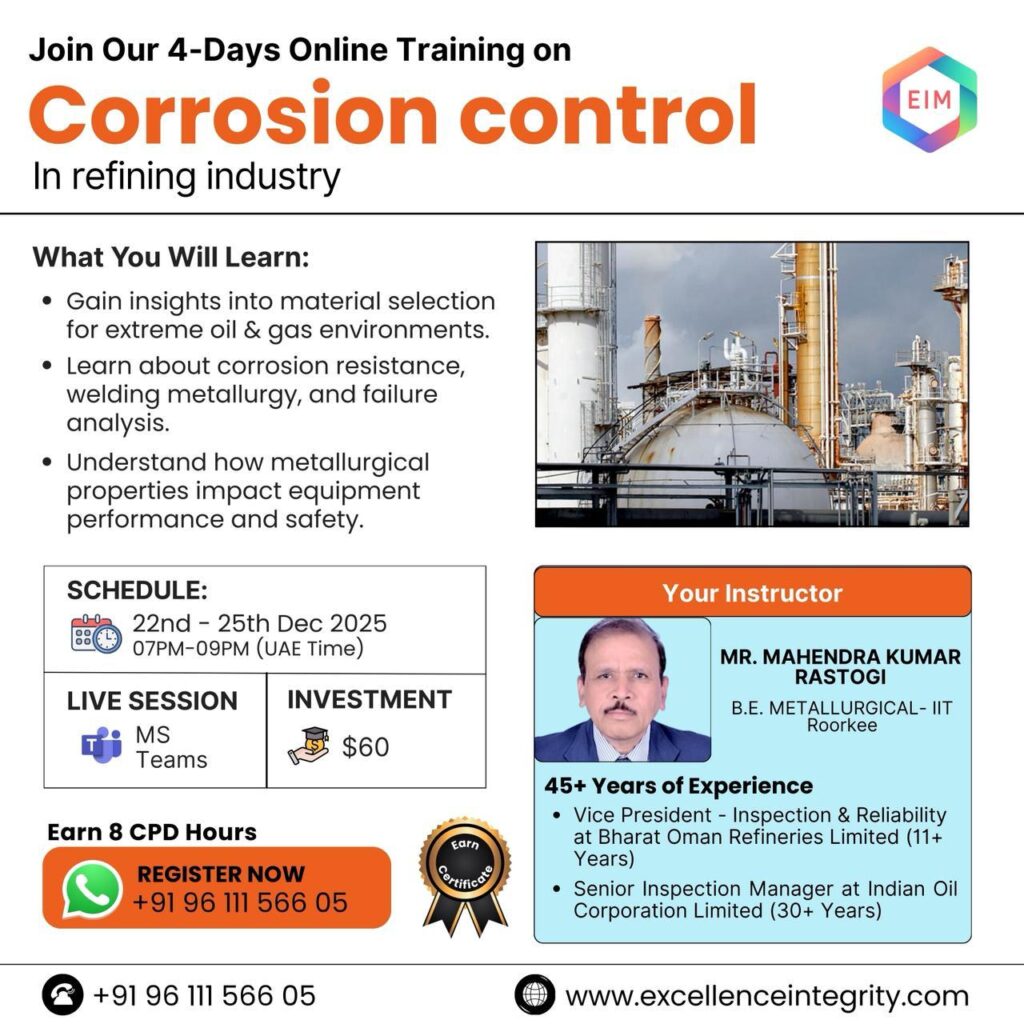

 Join Our 4-Days Live Online Training on FEED (Front End Engineering & Design)
 Subtotal: $150.00
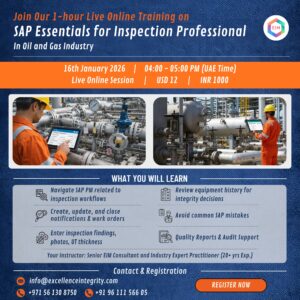
SAP Essentials for Inspection Professionals in the Oil & Gas Industry
Introduction
The oil and gas industry is one of the most asset-intensive and highly regulated sectors in the world. From upstream production facilities to downstream refineries and cross-country pipelines, inspection professionals play a vital role in maintaining safety, reliability, and regulatory compliance.
However, as facilities become more complex and infrastructure continues to age, traditional inspection tracking methods—spreadsheets, paper reports, and isolated databases—are no longer sufficient. This is where SAP becomes a critical enabler.
SAP is not just an ERP system; for inspection engineers, RBI specialists, corrosion engineers, and asset integrity professionals, SAP serves as the digital backbone for inspection planning, execution, documentation, and decision-making.
This blog provides a comprehensive, real-world guide to SAP essentials for inspection professionals in the oil & gas industry, covering:
-
SAP modules used in inspection
-
Inspection workflows
-
RBI and corrosion integration
-
Real industry case studies
-
Practical SAP inspection examples
-
Google E-E-A-T optimized structure
Why SAP Is Critical for Inspection Professionals
Inspection activities are deeply interconnected with maintenance, operations, materials, shutdowns, and regulatory audits. SAP enables all these functions to operate on a single integrated platform.
Key Reasons Oil & Gas Companies Use SAP for Inspection
-
Centralized inspection and asset data
-
Automated inspection scheduling
-
RBI-driven inspection planning
-
Seamless integration with maintenance work orders
-
Full inspection traceability for audits
-
Real-time reporting and analytics
For inspection professionals, SAP ensures inspection findings directly translate into risk reduction and maintenance action, rather than remaining isolated reports.
Understanding SAP in the Oil & Gas Inspection Context
SAP in oil & gas is used to manage:
-
Static equipment (pressure vessels, piping, tanks)
-
Inspection schedules and intervals
-
Corrosion and thickness monitoring
-
Risk-based inspection (RBI)
-
Turnarounds and shutdowns
-
Compliance with API, ASME, and ISO standards
The most relevant SAP modules for inspection professionals are:
-
SAP PM (Plant Maintenance)
-
SAP EAM (Enterprise Asset Management)
-
SAP S/4HANA Asset Management
-
SAP MM (Materials Management)
-
SAP PS (Project Systems)


Core SAP Modules Every Inspection Professional Must Know
1. SAP PM (Plant Maintenance) – The Backbone of Inspection
SAP PM is the most critical module for inspection professionals.
Key SAP PM Capabilities for Inspection:
-
Equipment and functional location hierarchy
-
Inspection task lists
-
Automated inspection notifications
-
Inspection-based work orders
-
Historical inspection records
Why It Matters:
SAP PM ensures inspections are planned, executed, documented, and closed systematically, supporting compliance with API 510, API 570, and API 653.
2. SAP EAM (Enterprise Asset Management)
SAP EAM extends PM for asset-intensive industries like oil & gas.
Benefits for Inspectors:
-
Full lifecycle asset visibility
-
Condition-based inspection support
-
Integration with RBI programs
-
Improved reliability and uptime
SAP EAM enables inspection teams to move from time-based inspection to risk-based strategies.
3. SAP S/4HANA Asset Management
Many oil & gas companies are migrating to SAP S/4HANA.
Inspection Advantages:
-
Real-time inspection analytics
-
Embedded dashboards
-
Improved mobile inspection capabilities
-
Faster reporting during audits and turnarounds
4. SAP MM (Materials Management)
Inspection findings often require immediate repairs.
SAP MM ensures:
-
Spare parts availability
-
Procurement linked to inspection defects
-
Reduced maintenance delays
5. SAP PS (Project Systems)
Used during:
-
Major shutdowns
-
Turnarounds
-
Asset replacement projects
Inspection results feed directly into project scope and cost tracking.
SAP Inspection Workflow (End-to-End)
-
Asset Structuring
-
Functional locations (plant → unit → system)
-
Equipment tagging
-
-
Inspection Planning
-
Inspection task lists
-
Inspection intervals
-
Applicable inspection techniques
-
-
Inspection Execution
-
Work order generation
-
Field inspection
-
Data entry
-
-
Evaluation & Notifications
-
Defects logged
-
Risk ranking updated
-
-
Maintenance Integration
-
Repair work orders
-
Material reservation
-
-
History & Compliance
-
Audit-ready documentation
-


SAP and Risk-Based Inspection (RBI)
SAP supports RBI by:
-
Storing Probability of Failure (PoF)
-
Linking Consequence of Failure (CoF)
-
Adjusting inspection intervals
-
Tracking risk reduction
This transforms SAP into a decision-support system, not just a data repository.
SAP for Corrosion Management
Corrosion is a major threat to oil & gas assets.
SAP enables:
-
Corrosion loop management
-
Thickness measurement tracking
-
Corrosion rate calculation
-
Trend analysis
-
Predictive maintenance planning
Inspection professionals can forecast degradation and prevent failures proactively.
SAP and Regulatory Compliance
SAP supports compliance with:
-
API 510 – Pressure Vessels
-
API 570 – Piping
-
API 653 – Storage Tanks
-
ASME Section VIII
-
ISO 55000
SAP ensures full inspection traceability, which is critical during regulatory audits.
Real-World SAP Inspection Case Studies
Case Study 1: Refinery Inspection Digitization
Challenge:
Overdue inspections, poor traceability, audit findings.
SAP Solution:
-
SAP PM inspection task lists
-
Automated notifications
-
Digital inspection history
Results:
✔ Zero missed inspections
✔ Faster audits
✔ Improved coordination
Case Study 2: SAP-Driven RBI for Piping Systems
Challenge:
Unplanned shutdowns due to corrosion.
SAP + RBI Integration:
-
Dynamic inspection intervals
-
Risk-based prioritization
Results:
✔ 25% inspection cost reduction
✔ Improved reliability
Case Study 3: SAP Inspection During Turnaround
Challenge:
Managing thousands of inspection points.
SAP Benefits:
-
Real-time inspection tracking
-
Defect criticality classification
Results:
✔ Reduced shutdown duration
✔ Better cost control
Case Study 4: Pipeline Integrity Management Using SAP
SAP Usage:
-
Pipeline segmentation
-
ILI data integration
-
Defect growth trending
Results:
✔ Improved regulatory reporting
✔ Early failure prevention
Real SAP Inspection Examples
Example 1: Pressure Vessel Inspection
-
Notification → Work Order → Inspection → Defect → Repair
Example 2: Corrosion Monitoring
-
Thickness trending → Corrosion rate → Remaining life
Example 3: Overdue Inspection Control
-
SAP dashboards highlight high-risk overdue assets
Career Benefits of SAP for Inspection Professionals
-
Higher employability
-
Leadership roles in asset integrity
-
Global oil & gas opportunities
-
Competitive salaries
SAP has become the foundation of inspection and asset integrity management in the oil & gas industry. Inspection professionals who combine field expertise with SAP knowledge are uniquely positioned to lead digital transformation initiatives, improve safety, and enhance asset reliability.
Mastering SAP essentials is no longer optional—it is a career-defining skill for modern inspection professionals.