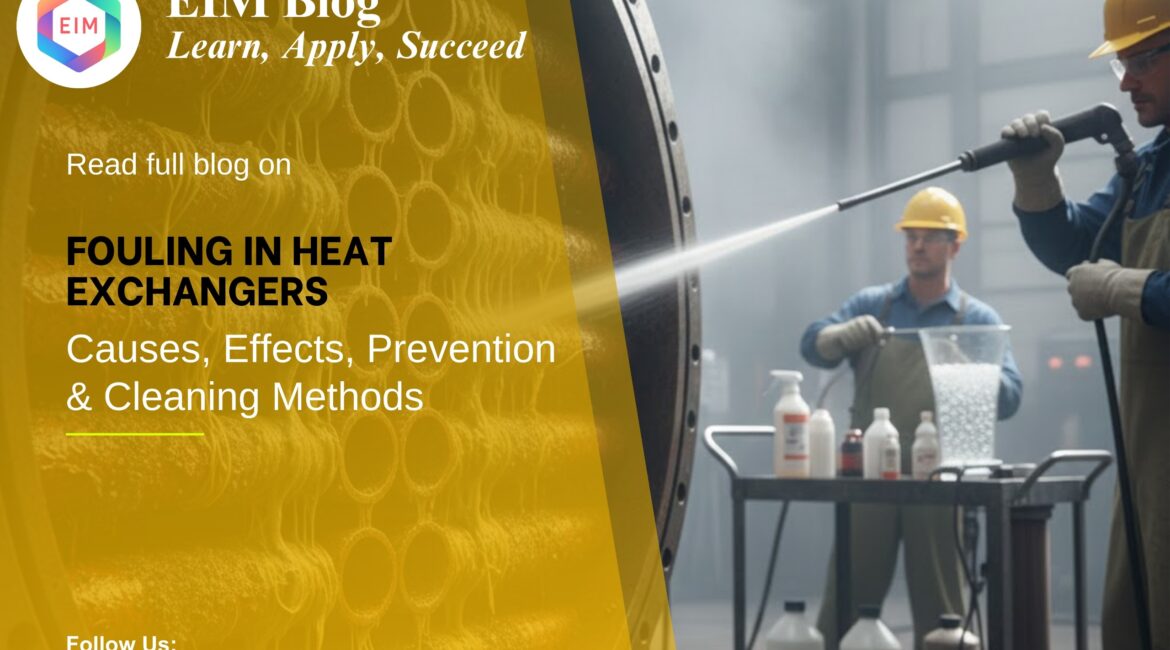
Heat exchangers are among the most critical pieces of equipment in refineries, petrochemical plants, power plants, and chemical processing units. They operate continuously under high temperature and pressure conditions, making them vulnerable to performance degradation over time. Among all operational challenges, fouling remains the most persistent and costly issue. It directly impacts heat transfer efficiency, production rates, equipment lifespan, and energy consumption.
This comprehensive guide explains what fouling is, why it occurs, how it affects plant operations, and the best practices for prevention and cleaning. Whether you work in maintenance, operations, or asset integrity management, understanding fouling is essential for improving reliability and reducing operational costs.
What Is Fouling in Heat Exchangers?
Fouling refers to the accumulation of unwanted deposits on heat transfer surfaces. These deposits act as insulating layers, reducing heat transfer capability and increasing pressure drop. Over time, fouling forces equipment to work harder, leading to energy losses and unplanned shutdowns.
Fouling is influenced by fluid composition, temperature variations, flow velocity, heat exchanger design, and operating environment. Even well-designed systems experience fouling to some degree, but proper monitoring and maintenance can significantly reduce its impact.
Types of Fouling in Heat Exchangers
Understanding the different types of fouling helps engineers diagnose the root cause and select the right cleaning strategy. The major types include:
1. Chemical Fouling
Chemical fouling occurs when dissolved chemicals react with heat transfer surfaces to form solid deposits. This is common when the fluid undergoes chemical decomposition at high temperatures.
Examples:
-
Polymerization of hydrocarbons
-
Chemical reactions forming scale
-
Thermal degradation of process fluids
Industries impacted: Refineries, petrochemical units, chemical plants.
2. Biological Fouling (Biofouling)
Biofouling is caused by the growth of microorganisms such as algae, bacteria, fungi, and slime. It typically occurs in cooling water systems and low-temperature operations.
Common scenarios:
Biofouling reduces heat transfer efficiency and creates corrosion-related problems.
3. Particulate Fouling
This type of fouling happens when solid particles become suspended in the fluid and settle on heat transfer surfaces.
Typical causes:
Particulate fouling is common in crude processing, wastewater handling, and open-loop cooling systems.
4. Crystallization Fouling (Scale Formation)
Crystallization fouling occurs when dissolved minerals exceed saturation levels and precipitate out of the fluid. These minerals form a hard, insulating layer on heat exchanger surfaces.
Typical deposits:
-
Calcium carbonate
-
Silica
-
Sulfates
-
Phosphates
This is commonly observed in boilers, cooling water systems, and any application involving high temperatures.
5. Corrosion Fouling
Corrosion products from pipes or equipment can form deposits inside heat exchangers, restricting flow and reducing heat transfer.
Examples include:
This type of fouling is often linked with poor material selection or inadequate corrosion control.
6. Freezing Fouling
In low-temperature operations, fluids may partially freeze, creating blockages in heat exchanger channels.
Example:
This type is less common but can cause severe operational damage.
Causes of Fouling in Heat Exchangers
Fouling is not a single-event problem—it develops gradually due to a combination of operating and environmental factors. The primary causes include:
1. Poor Fluid Quality
Impurities, suspended solids, biological growth, and corrosive chemicals accelerate fouling.
2. Incorrect Operating Conditions
Sudden changes in temperature or pressure create conditions that encourage crystallization or chemical reactions.
3. Low Flow Velocity
Slow-moving fluids allow particles to settle and form deposits. Maintaining turbulent flow helps minimize fouling.
4. Inadequate Water Treatment
Cooling water without proper treatment leads to scale, corrosion, and biofouling.
5. High Temperature Surfaces
Excessive temperatures promote:
-
Thermal decomposition
-
Polymerization
-
Scaling
6. Design Limitations
Older or improperly designed exchangers may have:
-
Dead zones
-
Narrow flow passages
-
Low turbulence areas
All of these encourage deposition.
Effects of Fouling in Heat Exchangers
Fouling has both short-term and long-term effects. Some are visible immediately, while others are only detected during maintenance.
1. Reduced Heat Transfer Efficiency
Deposits act as insulation, slowing down heat exchange and reducing thermal performance.
2. Increased Pressure Drop
As deposits accumulate, flow passages narrow and resistance increases, leading to higher energy consumption.
3. Higher Operating Costs
To compensate for reduced performance, systems require:
These significantly increase energy consumption.
4. Frequent Shutdowns and Maintenance
Severe fouling can force unplanned shutdowns, resulting in production loss.
5. Accelerated Corrosion
Some types of fouling trap moisture or corrosive chemicals, creating under-deposit corrosion.
6. Shortened Equipment Life
Continuous fouling reduces the lifespan of tubes, plates, and gaskets, leading to costly replacements.
How to Prevent Fouling in Heat Exchangers
Preventing fouling is more cost-effective than cleaning. Plants use a combination of operational controls, chemical treatment, and mechanical solutions to minimize fouling formation.
1. Proper Water Treatment Programs
For cooling water systems, this includes:
-
Filtration
-
Chlorination
-
Anti-scaling chemicals
-
Corrosion inhibitors
-
Microbiological control
A well-managed water treatment program can reduce fouling by up to 60%.
2. Maintain Optimal Flow Conditions
Increasing turbulence inside tubes or plates prevents particles from settling. Engineers can:
3. Control Temperature Gradients
Avoiding excessively high temperatures reduces:
-
Scaling
-
Chemical reactions
-
Polymerization
Temperature control is especially important in crude units.
4. Improve Fluid Filtration
Using filters or strainers helps remove particulates before they enter the heat exchanger.
5. Use Anti-Fouling Materials or Coatings
Special coatings prevent deposits from sticking. Materials like titanium and high-grade stainless steel resist corrosion and fouling.
6. Chemical Injection Systems
In oil & gas processing, chemicals like dispersants, anti-foulants, and corrosion inhibitors help prevent deposit formation.
7. Routine Monitoring and Predictive Maintenance
Use:
Early detection reduces downtime and cleaning frequency.
Cleaning Methods for Fouled Heat Exchangers
Even with preventive strategies, fouling is unavoidable. Plants use a combination of mechanical and chemical cleaning methods depending on the fouling type and heat exchanger design.
1. Mechanical Cleaning
A. High-Pressure Water Jetting
Removes hard scale deposits from tubes and plates.
-
Effective for shell & tube exchangers
-
Removes scale, sludge, rust
B. Mechanical Tube Cleaning
Tools like brushes, scrapers, or pigs are inserted into tubes to remove stubborn deposits.
C. Hydro-lancing
Uses high-pressure jets to target heavy fouling areas.
D. Sponge Ball Cleaning (Online Cleaning)
Used mostly in condenser and cooling systems. Sponge balls circulate and clean tubes continuously during operation.
2. Chemical Cleaning
Chemical cleaning dissolves deposits using controlled chemical reactions.
Commonly used chemicals include:
-
Acid cleaners for scale
-
Alkaline cleaners for organic fouling
-
Solvent cleaners for hydrocarbons
-
Biocides for biological fouling
Chemical cleaning is effective in tight spaces where mechanical tools cannot reach.
3. CIP (Clean-In-Place) Systems
Widely used for plate heat exchangers. This automated system circulates cleaning solutions without dismantling the equipment.
Benefits:
-
Reduces manpower
-
Minimizes downtime
-
Ensures uniform cleaning
4. Thermal Cleaning
Deposits are burnt off using high-temperature gases. This method is used in severe polymer fouling or coke formation cases in refineries.
Best Practices for Effective Fouling Management
To minimize fouling long-term, follow these industry best practices:
-
Maintain a comprehensive inspection schedule
-
Analyze deposit samples to understand causes
-
Use real-time monitoring systems
-
Optimize chemical dosing
-
Install strainers and filters where needed
-
Ensure proper commissioning and startup procedures
-
Train operators and maintenance teams regularly
Effective fouling management reduces downtime, improves reliability, and boosts energy efficiency across the plant.
Conclusion
Fouling in heat exchangers is a major operational challenge across the oil & gas, power, chemical, and processing industries. Understanding the different types of fouling—chemical, biological, particulate, scaling, corrosion, and freezing—helps engineers implement targeted prevention and cleaning strategies. With the right combination of water treatment, optimized flow conditions, chemical injection, filtration, predictive maintenance, and regular cleaning, plants can significantly reduce fouling-related downtime and extend equipment life.
By taking proactive measures and implementing structured fouling management programs, companies can save millions annually in energy, maintenance, and production costs.
 Corrosion control In refining industry
1 × $60.00
Corrosion control In refining industry
1 × $60.00