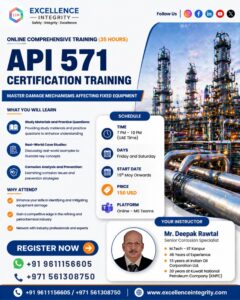

API 571 Certification: Complete Guide to Pressure Equipment Inspection for GCC Professionals
Discover the complete API 571 Certification Guide for GCC professionals. Learn damage mechanisms, metallurgy, inspection methods, corrosion control, API code integration, exam preparation, salary benefits, and career opportunities in oil & gas industries.
API 571 Certification Guide (2026)
The oil and gas industry in the GCC region operates under some of the harshest process conditions in the world. Refineries, LNG terminals, offshore platforms, petrochemical plants, and pipeline networks in Saudi Arabia, UAE, Qatar, Kuwait, Oman, and Bahrain continuously face challenges related to corrosion, material degradation, hydrogen damage, stress corrosion cracking, and high-temperature failures.
As facilities age and production targets increase, companies are investing heavily in inspection, metallurgy, and asset integrity programs.
This growing demand has made API 571 certification one of the most valuable credentials for inspection engineers, corrosion specialists, reliability professionals, and metallurgists.
API 571 focuses on understanding how fixed equipment deteriorates, why failures occur, and how inspection professionals can identify and prevent damage before catastrophic incidents happen.
This guide explains everything GCC professionals need to know about API 571 certification, including:
- Damage mechanisms affecting pressure equipment
- Corrosion and metallurgy fundamentals
- Inspection technologies
- API code integration
- Fitness-for-Service concepts
- Exam preparation strategies
- GCC industry demand
- Salary benefits and career opportunities
- Future trends in asset integrity
What is API 571?
API 571, officially titled Damage Mechanisms Affecting Fixed Equipment in the Refining Industry, is a recommended practice published by the American Petroleum Institute.
The document provides detailed technical guidance on deterioration mechanisms affecting:
- Pressure vessels
- Process piping
- Heat exchangers
- Storage systems
- Boilers and heaters
- Refinery process equipment
API 571 is widely used across:
- Refineries
- Petrochemical plants
- LNG facilities
- Offshore production platforms
- Gas processing plants
- Pipeline operations
The standard helps professionals understand:
- How materials degrade
- Which process conditions accelerate corrosion
- Why cracking occurs
- What inspection methods should be applied
- How to prevent failures
- How to improve equipment reliability
Why API 571 is Important in GCC Countries
The GCC region contains some of the world’s largest hydrocarbon processing facilities.
These facilities operate under severe conditions including:
- High ambient temperatures
- Chloride-rich marine environments
- Sour service exposure
- High sulfur crude processing
- Extreme thermal cycling
- High-pressure hydrogen systems
Because of these conditions, corrosion and material degradation become major operational risks.
API 571 helps engineers identify damage before failures occur.
Saudi Arabia
Large refining and petrochemical complexes require professionals with strong knowledge of:
- Sulfidation
- Hydrogen damage
- Creep
- Corrosion under insulation
United Arab Emirates
Major offshore and ADNOC projects emphasize asset integrity and reliability management.
Qatar
LNG facilities require deep understanding of low-temperature metallurgy and corrosion management.
Kuwait
Refinery modernization projects create high demand for inspection specialists.
Oman
Enhanced oil recovery operations increase risks associated with corrosion and thermal damage.
Bahrain
Process optimization and refinery upgrades continue driving demand for API-certified professionals.
Core Technical Areas Covered in API 571
API 571 focuses primarily on understanding deterioration mechanisms affecting fixed equipment.
Materials and Metallurgy
Understanding metallurgy is essential for predicting equipment behavior.
Carbon Steel
Carbon steel is widely used because of:
- Cost-effectiveness
- Strength
- Easy fabrication
- Availability
However, carbon steel is vulnerable to:
- Uniform corrosion
- Sulfidation
- Wet H2S damage
- Hydrogen-induced cracking
- MIC
- CUI
Stainless Steel
Stainless steels offer better corrosion resistance but may suffer from:
- Chloride SCC
- Pitting corrosion
- Crevice corrosion
- Polythionic acid cracking
- Sigma phase embrittlement
Nickel Alloys
Nickel-based alloys are commonly used in:
- High-temperature systems
- Acidic environments
- Severe corrosion services
- Offshore facilities
These materials provide superior resistance but require advanced inspection knowledge.
Major Damage Mechanisms in API 571
Uniform Corrosion
Uniform corrosion affects the metal surface evenly.
Common Causes
- Oxygen contamination
- Acidic environments
- Water exposure
- Chemical attack
Inspection Methods
- Ultrasonic thickness testing
- Visual inspection
- Corrosion monitoring
- Online sensors
Pitting Corrosion
Pitting causes highly localized metal loss.
High-Risk Areas
- Heat exchangers
- Cooling systems
- Stainless steel piping
- Dead legs
Typical Causes
- Chlorides
- Stagnant process conditions
- Breakdown of passive films
Stress Corrosion Cracking (SCC)
SCC occurs when tensile stress combines with a corrosive environment.
Important Types
- Chloride SCC
- Caustic cracking
- Sulfide stress cracking
- Amine SCC
- Polythionic acid cracking
This is highly relevant in GCC facilities because of elevated temperatures and chloride exposure.
Hydrogen Damage
Hydrogen damage is one of the most critical damage mechanisms in refining industries.
Major Types
- Hydrogen blistering
- HIC
- SOHIC
- High-temperature hydrogen attack
Common Locations
- Hydroprocessing units
- Desulfurization systems
- Hydrogen reactors
- Sour water systems
Inspection Techniques
- Advanced UT
- PAUT
- TOFD
- Metallographic replication
Creep Damage
Creep occurs under prolonged exposure to elevated temperatures.
Commonly Affected Equipment
- Furnace tubes
- Steam lines
- High-temperature reactors
- Reformers
Typical Indicators
- Bulging
- Distortion
- Cracking
- Metallurgical changes
Thermal Fatigue
Thermal fatigue results from repeated temperature fluctuations.
Common Areas
- Mixing points
- Injection systems
- Dead legs
- Start-up and shutdown systems
Erosion-Corrosion
Erosion-corrosion combines metal loss with high fluid velocity.
High-Risk Systems
- Slurry pipelines
- Elbows
- Produced water systems
- Pump discharge piping
Corrosion Under Insulation (CUI)
CUI is one of the costliest forms of corrosion in the oil and gas industry.
Causes
- Moisture ingress
- Damaged insulation
- Chloride contamination
- Poor weather protection
Inspection Methods
- Guided wave UT
- Pulsed eddy current
- Insulation removal inspection
- Drone-assisted monitoring
Microbiologically Influenced Corrosion (MIC)
MIC occurs due to bacterial activity inside process systems.
Commonly Affected Systems
- Firewater systems
- Cooling water systems
- Produced water pipelines
- Storage tanks
Dealloying
Dealloying selectively removes alloying elements from materials.
Examples
- Dezincification
- Graphitization
- Dealuminification
Fitness-for-Service (FFS) Concepts
API 571 knowledge supports Fitness-for-Service assessments according to API 579-1/ASME FFS-1.
FFS evaluations determine whether damaged equipment can continue operating safely.
Key Assessment Factors
- Damage severity
- Remaining strength
- Remaining life
- Failure probability
- Risk level
- Repair feasibility
Understanding damage mechanisms is critical for accurate FFS decision-making.
Inspection Technologies Used in API 571 Applications
Modern inspection programs rely heavily on advanced NDT technologies.
Ultrasonic Testing (UT)
Used for:
- Thickness measurements
- Corrosion mapping
- Remaining life calculations
Phased Array Ultrasonic Testing (PAUT)
Commonly applied for:
- Weld inspection
- Crack sizing
- Hydrogen damage evaluation
Time of Flight Diffraction (TOFD)
Provides highly accurate crack detection.
Radiographic Testing (RT)
Used for:
- Weld quality evaluation
- Internal defect detection
- Corrosion assessment
Eddy Current Testing
Widely used for:
- Heat exchanger tubes
- Surface crack detection
- Corrosion identification
Acoustic Emission Testing
Useful for:
- Tank monitoring
- Leak detection
- Structural assessment
API Standards Integration
API 571 supports multiple inspection and integrity standards.
API 510
Supports pressure vessel inspection by identifying:
- Damage mechanisms
- Corrosion risks
- Inspection locations
API 570
Provides understanding of:
- Piping deterioration
- Corrosion loops
- Injection point monitoring
API 579-1
Damage mechanism knowledge is essential for Fitness-for-Service evaluations.
ASME BPVC
Supports pressure equipment integrity and material selection.
NACE Standards
API 571 complements corrosion mitigation and materials engineering practices.
Career Opportunities After API 571 Certification
API 571 certification creates strong career opportunities across GCC industries.
Common Roles
Inspection Engineer
Responsible for:
- Inspection planning
- Damage assessment
- Integrity management
Corrosion Engineer
Focuses on:
- Corrosion mitigation
- Failure prevention
- Material selection
Asset Integrity Engineer
Manages:
- RBI programs
- Reliability systems
- Risk assessments
Metallurgical Engineer
Provides expertise in:
- Material degradation
- Failure analysis
- Welding metallurgy
RBI Specialist
Develops:
- Risk-based inspection programs
- Corrosion assessments
- Inspection intervals
Salary Benefits in GCC Countries
API-certified professionals are highly valued across the Middle East.
Estimated Benefits
Professionals with API 571 certification often receive:
- 30–50% salary premium
- Better international opportunities
- Faster career growth
- Access to major EPC projects
Industries Hiring API 571 Professionals
- Refineries
- LNG plants
- Offshore facilities
- Petrochemical complexes
- Pipeline operations
- Power generation facilities
Digitalization and the Future of Asset Integrity
The inspection industry is rapidly evolving with digital technologies.
Online Corrosion Monitoring
Facilities increasingly use:
- Smart corrosion sensors
- Wireless monitoring systems
- Real-time integrity dashboards
Predictive Analytics
AI-based systems help predict:
- Corrosion growth rates
- Failure probabilities
- Remaining equipment life
Digital Twins
Digital twins simulate:
- Equipment degradation
- Operational stress
- Inspection optimization
Robotics and Drone Inspection
Used for:
- Tank inspections
- Offshore structures
- High-risk access areas
Common Misconceptions About API 571
“API 571 is only for inspectors”
Incorrect.
The certification benefits:
- Corrosion engineers
- Reliability professionals
- Metallurgists
- Asset integrity specialists
- Maintenance engineers
“Memorization is enough”
API 571 requires conceptual understanding and real-world application knowledge.
“Only refinery professionals need API 571”
The certification is valuable across:
- Upstream operations
- LNG facilities
- Petrochemical industries
- Pipelines
- Power plants
Frequently Asked Questions
Is API 571 difficult?
Yes. The examination is considered technically challenging because it focuses heavily on understanding corrosion and metallurgy.
Who should pursue API 571?
Ideal candidates include:
- Inspection engineers
- Corrosion specialists
- Metallurgists
- Reliability engineers
- API 510 and API 570 inspectors
Is API 571 valuable in the GCC region?
Absolutely.
The GCC has severe operating conditions that make damage mechanism expertise highly valuable.
Does API 571 improve salary potential?
Yes. Certified professionals often receive better compensation and stronger career opportunities.
Which industries value API 571 certification?
- Oil & gas
- LNG
- Petrochemicals
- Refineries
- Pipelines
- Power generation
Conclusion
API 571 certification is one of the most valuable technical credentials for professionals working in inspection, metallurgy, corrosion engineering, and asset integrity management.
For GCC professionals, the certification provides a strong competitive advantage in industries operating under severe environmental and process conditions.
As oil and gas projects continue expanding across Saudi Arabia, UAE, Qatar, Kuwait, Oman, and Bahrain, the demand for professionals with deep understanding of damage mechanisms and inspection technologies will continue growing.
API 571 is not only important for examination success — it is essential for improving safety, reliability, operational efficiency, and long-term asset integrity in modern process industries.
Professionals who invest in API 571 certification position themselves for:
- Higher salaries
- Better career growth
- Technical specialization
- Leadership opportunities
- Long-term industry relevance
FAQs: API 571 Certification Questions Answered
Q: How long does API 571 certification remain valid? A: API 571 certification doesn’t have a formal expiration, but staying current with standards updates is professional best practice. New editions of API 571 are released periodically, and continued professional development is strongly recommended.
Q: Can I take API 571 without prior inspection experience? A: Technically yes, but most candidates have 2-5 years of inspection or materials engineering background. The exam is significantly more challenging without practical experience. Many recommend 2-3 years of field exposure before attempting certification.
Q: What’s the difference between API 571 and API 510/570? A: API 571 is the foundational metallurgy and deterioration mechanism standard. API 510 covers pressure vessel inspection procedures, while API 570 covers piping inspection. Many inspectors pursue all three certifications for comprehensive competency.
Q: Is API 571 recognized outside the GCC? A: Yes, API standards are globally recognized. API 571 is respected in the Middle East, North America, Europe, and Asia. It significantly improves employability in any international oil & gas, petrochemical, or power generation operation.
Q: How much does API 571 certification cost? A: Standard + Study Resources: $150-250; Training Course: $1,500-3,500; Exam Fee: $300-400. Total investment: approximately $2,000-4,000 USD. Many employers sponsor training costs for promising technical employees.
Q: What is the pass rate for API 571? A: First-attempt pass rate is approximately 55-65%, depending on preparation quality. With dedicated study and practice exams at 80%+ accuracy, pass rates on first attempt exceed 80%.
Q: Can I use reference materials during the API 571 exam? A: No, API 571 is a closed-book exam. However, you’re permitted to bring an approved calculator. Some test centers allow blank paper for calculations.
Q: How does API 571 differ from manufacturer training or operator-specific courses? A: API 571 provides industry-wide, globally recognized competency standards based on best practices across thousands of facilities. Manufacturer and operator training is valuable and specific, but API 571 provides broader, transferable knowledge that improves career mobility.