Excellence Integrity Management brings together tailored-fit Human resourcing, Learning and Development, Talent Management, and Asset Integrity Management solutions to diverse clients.

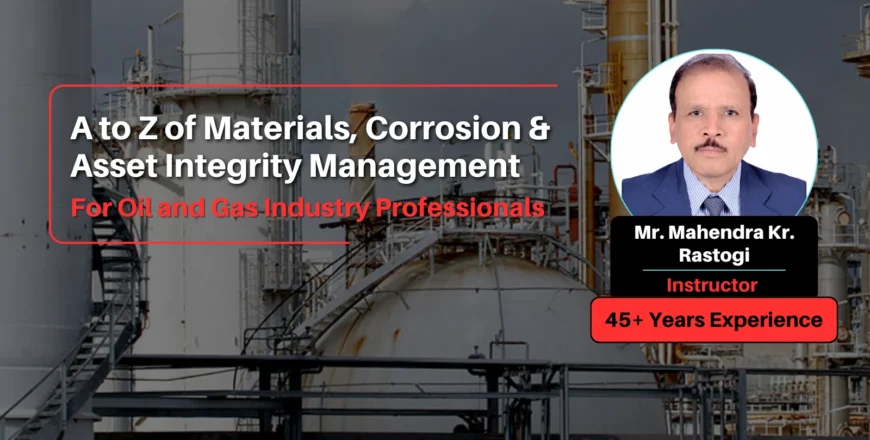
The A to Z of Materials, Corrosion & Asset Integrity Management program is a 100+ hour long-term technical training program designed to develop both technical expertise and leadership capability required to manage integrity in ageing engineering assets.
The course goes beyond theoretical learning and focuses on developing practical capabilities needed to manage corrosion, materials degradation, inspection strategies, and asset integrity in real industrial environments.
The main objective of the program is to help professionals:
Lead asset integrity management initiatives
Prevent catastrophic failures in industrial facilities
Promote a proactive reliability culture
Implement safe, reliable, practical, and techno-economically feasible solutions
Integrate design, operations, inspection, and materials engineering
Managing ageing assets requires coordinated collaboration between materials, corrosion, operations, inspection, process, utilities, and management teams. This program develops the integrated engineering mindset required for effective asset integrity leadership.
The program is delivered live online with interactive sessions, covering 20 technical modules across 25 classes, more than 100 hours of learning.
This program provides comprehensive knowledge covering materials engineering, corrosion science, inspection standards, risk assessment, and asset integrity management.
Participants will learn the following key areas:
Participants will understand atomic structure, crystal systems, mechanical properties, manufacturing processes, and heat treatment of steels used in industrial applications.
The program covers different engineering alloys including stainless steels, nickel-based alloys, titanium, copper, and aluminium alloys, along with their selection for oil and gas environments.
Participants will study electrochemical corrosion principles, corrosion thermodynamics and kinetics, various corrosion types, and environmental factors influencing corrosion.
The course explores corrosion problems in real industrial facilities such as refineries, petrochemical plants, pipelines, LNG systems, and power plants.
Participants will learn about metallurgical damage, mechanical degradation, high-temperature damage mechanisms, and corrosion processes that lead to material thinning.
Topics include stress corrosion cracking (SCC), hydrogen damage, hydrogen induced cracking (HIC), and mitigation strategies used in sour environments.
Participants will study major international standards including:
API 570 – Piping Inspection
API 510 – Pressure Vessel Inspection
API 650 / 653 – Storage Tanks
ASME B31.3 – Process Piping
ASME Section V and IX – NDT and welding qualifications
The program explains RBI methodology including probability and consequence analysis, risk matrix development, and inspection planning strategies.
Participants will learn how to evaluate equipment integrity using API 579 / ASME PCC-2, including flaw assessment and repair methodologies.
The program covers failure investigation techniques, metallurgical evaluation, fractography basics, and preventive action planning.
Participants will understand corrosion mitigation techniques including cathodic protection systems, coatings, chemical inhibitors, and treatment programs.
The course concludes with strategies for managing integrity across entire facilities, integrating inspection data, and implementing proactive reliability programs.
This program is designed for professionals working in industries where materials degradation, corrosion, and asset integrity management are critical.
It is ideal for:
Inspection Engineers
Corrosion Engineers
Materials and Metallurgy Engineers
Pipeline Engineers
Reliability Engineers
Integrity and Maintenance Professionals
Technical leaders responsible for managing ageing assets