
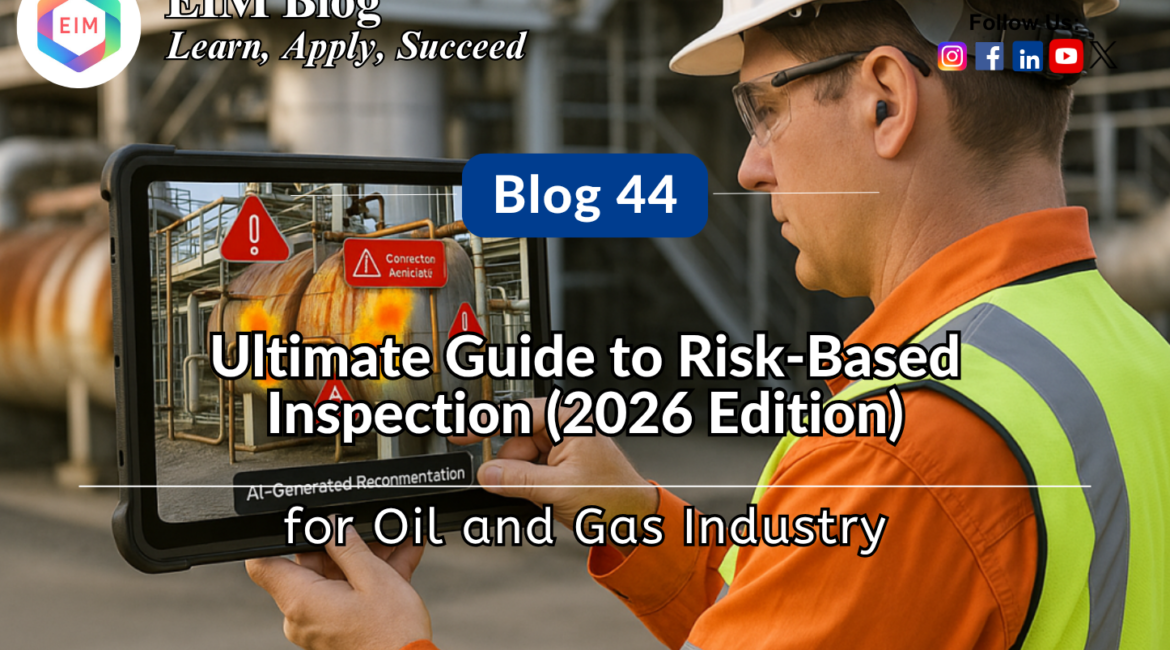
Ultimate Guide to Risk-Based Inspection (RBI) in Oil & Gas (2026 Edition)
Table of Contents
- Introduction to RBI
- What is Risk-Based Inspection?
- RBI Methodologies (Qualitative vs Quantitative)
- RBI Risk Matrix Explained (Interactive Concept)
- Damage Mechanisms in Oil & Gas
- RBI Standards & Compliance
- RBI Implementation Roadmap (7 Phases)
- RBI for Pipelines, Offshore & Refineries
- Challenges in RBI Implementation
- Future of RBI: AI, Digital Twins & Smart Inspection
1. Introduction to RBI
The oil and gas industry operates in one of the most high-risk industrial environments, where equipment failure can lead to catastrophic consequences—financial, environmental, and human.
Traditional inspection strategies, based on fixed schedules, often fail to identify real risk exposure. This leads to:
- Over-inspection of low-risk assets
- Under-inspection of critical equipment
2. What is Risk-Based Inspection (RBI)?
RBI is a methodology that prioritizes inspection based on:
Risk = Probability of Failure (PoF) × Consequence of Failure (CoF)
Key Elements:
- PoF: Corrosion, fatigue, material degradation
- CoF: Safety impact, environmental damage, production loss
Types of RBI:
- Qualitative RBI → Expert judgment, risk ranking
- Semi-Quantitative RBI → Scoring models
- Quantitative RBI (API 581) → Mathematical risk calculations
Most advanced oil & gas operators today use quantitative RBI for high-value assets.
3. RBI Methodologies (Qualitative vs Quantitative)
| Method | Description | Use Case |
|---|---|---|
| Qualitative | Expert-based ranking | Small plants |
| Semi-Quantitative | Scoring system | Medium facilities |
| Quantitative (API 581) | Data-driven calculations | Refineries, offshore |
Key Insight:
- Qualitative → Faster but less precise
- Quantitative → Accurate but data-intensive
Best practice: Hybrid RBI approach
4. RBI Risk Matrix Explained
5×5 Risk Matrix Structure
| PoF \ CoF | Low | Medium | High | Very High | Severe |
|---|---|---|---|---|---|
| Very Low | Low | Low | Medium | Medium | High |
| Low | Low | Medium | Medium | High | High |
| Medium | Medium | Medium | High | High | Critical |
| High | Medium | High | High | Critical | Critical |
| Very High | High | High | Critical | Critical | Critical |
Risk Levels:
- 🟢 Low → Minimal inspection
- 🟡 Medium → Scheduled inspection
- 🟠 High → Frequent inspection
- 🔴 Critical → Immediate action
This matrix is the core decision-making tool in RBI programs.
5. Damage Mechanisms in Oil & Gas
Major Damage Mechanisms (Examples)
Corrosion Mechanisms:
- CO₂ Corrosion
- H₂S Corrosion
- Naphthenic Acid Corrosion
- Microbiologically Influenced Corrosion (MIC)
Cracking Mechanisms:
- Stress Corrosion Cracking (SCC)
- Sulfide Stress Cracking (SSC)
- SOHIC (Stress-Oriented Hydrogen Induced Cracking)
High-Temperature Damage:
- HTHA (High-Temperature Hydrogen Attack)
- Creep Damage
- Thermal Fatigue
Other Critical Mechanisms:
- Corrosion Under Insulation (CUI)
- Erosion-Corrosion
- Mechanical Fatigue
Advanced RBI models integrate 60+ damage mechanisms for accurate risk prediction.
6. RBI Standards & Compliance
To ensure global reliability, RBI follows international standards:
Key Standards:
- API 580 – RBI framework
- API 581 – Quantitative methodology
- ASME PCC-3 – Inspection planning
- DNV-RP-G101 – Risk-based inspection offshore
- ISO 31000 – Risk management
Why Standards Matter:
- Ensure consistency
- Improve audit compliance
- Enable global benchmarking
7. RBI Implementation Roadmap (7 Phases)
Phase 1: Define Scope
- Identify assets and systems
Phase 2: Data Collection
- Design data
- Inspection history
- Operating conditions
Phase 3: Damage Mechanism Review
- Identify applicable degradation modes
Phase 4: Risk Analysis
- Calculate PoF & CoF
Phase 5: Risk Ranking
- Prioritize equipment
Phase 6: Inspection Planning
- Define intervals & NDT techniques
Phase 7: Implementation & Review
- Continuous monitoring & updates
This structured approach ensures accurate, scalable RBI deployment.
8. RBI Applications: Pipelines, Offshore & Refineries
Pipeline RBI
- Focus on corrosion, leakage, pressure failure
Offshore RBI
- Harsh environments → High risk
- Structural fatigue & marine corrosion
Refinery RBI
- Complex systems → Heat exchangers, vessels
- High-temperature damage mechanisms
Each sector requires customized RBI models.
9. Challenges in RBI Implementation
- Poor or missing data
- High initial investment
- Lack of skilled professionals
- Resistance to digital transformation
Solution:
- Expert-led implementation
- Custom RBI software
- Training programs
- Digital integration
10. Future of RBI (2026 & Beyond)
The next generation of RBI is intelligent, automated, and predictive.
Emerging Technologies:
- AI-driven risk prediction
- Machine learning corrosion modeling
- Digital twins for simulation
- Drone-based inspections
- IoT real-time monitoring
RBI is evolving from static analysis → real-time intelligence system
Conclusion
Risk-Based Inspection is no longer optional—it is a strategic necessity for modern oil & gas operations.
You can achieve:
- Safer operations
- Reduced costs
- Higher reliability
- Future-ready infrastructure